Category: Client Insider

  • AI’s Impact on SEO: Your Top Questions Answered – February Client Insider

    AI’s Impact on SEO: Your Top Questions Answered – February Client Insider

    The Client Insider - Search Influence

    Stay Competitive in an AI Search World

    Worried About AI’s Impact? We’re Here to Help

    The rise of AI in search engines – often referred to as AI Search or AI Answers – is transforming the digital landscape, reshaping how businesses approach SEO.

    On Google, AI-generated snippets called AI Overviews appear at the top of search results and summarize information from various websites, creating a new opportunity to be found by searchers.

    Meanwhile, AI chatbots (ChatGPT, Gemini) and search engines (Perplexity, SearchGPT) generate direct answers to user questions, further shifting search behaviors.

    Our clients’ industries are impacted in varying ways. Sectors relying on informational content face the greatest challenges, as AI Answers are most often sought and generated for high-funnel, informational searches. Many clients’ traffic and revenue come from high-intent, local, and transactional searches – and the great news is that these remain less affected by AI Search.
    AI Search Graphic

    As AI Search evolves, we are adapting your SEO strategy to maximize visibility and traffic. That’s why we’re sharing our perspective on the top questions our clients are asking:

    1. Why should I care to show up in AI Answers?

    AI Answers like Google’s AI Overviews provide brand impressions—even if you don’t get the click—giving you exposure that your competitors aren’t getting. With platforms like ChatGPT and Perplexity gaining popularity, appearing in AI-generated answers offers a chance to boost visibility, position your brand as an authoritative source, and drive audience trust and engagement.

    2. How do I get AI to trust my website as a source?

    Traditional SEO tactics remain essential for supporting visibility in AI Answers, because AI models value sites with authority, expertise, and trustworthiness:

    • High-quality content that’s informative, relevant, and easy to digest and scan
    • Technical SEO tactics like meta descriptions, title tags, and schema markup
    • A seamless user experience including site speed, mobile optimization, and easy navigation

    When our strategists identify queries (keywords) that are relevant to your business and produce an AI Answer, they will deploy tactics designed to improve your visibility:

    • Use conversational language to match AI and voice queries
    • Add FAQ sections that directly answer questions AI looks for
    • Leverage long-tail keywords to answer specific queries that likely trigger AI responses
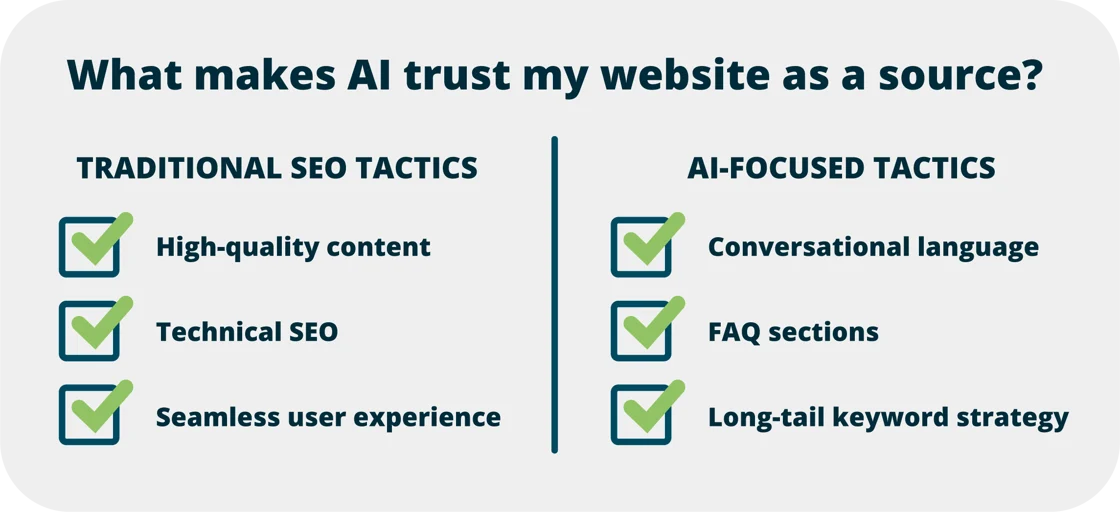
    What makes AI trust my website as a source - Search Influence

    3. Why is it still important to rank in organic results?

    It’s not all about AI Answers. For one client, of 312,000 keywords, only 464 generate AI Overviews. While AI is impacting informational searches, organic rankings are still critical for attracting qualified leads—not just for appearing in AI Answers, but for non-informational keywords. Organic results remain key for high-intent, local, and transactional searches where purchase decisions are made.

    4. How will AI’s role in search evolve?

    AI Search will continue to advance, and we’ll see more internet users trust and use these kinds of answers. Search engines like Google will focus even more on brand trust and authority, meaning it’s not just about optimizing content anymore—it’s about proving your expertise, reliability, and credibility. Strong performance in AI-driven results will be crucial, and we’ll likely see AI Answers expand further beyond search engines, as we’re already beginning to see on social media.

    Reach out to your Account Manager today to discuss how we’re helping you stay competitive in the AI Search landscape.
  • What Does “Optimize” Really Mean? – January Client Insider

    What Does “Optimize” Really Mean? – January Client Insider


    Trust your Marketing to a Team, Not a Machine

    Expert oversight, constant adjustments, and data-driven strategies to drive results.

    Success in advertising requires more than just automation—it takes a human touch. Ever wondered what goes into managing your campaigns?

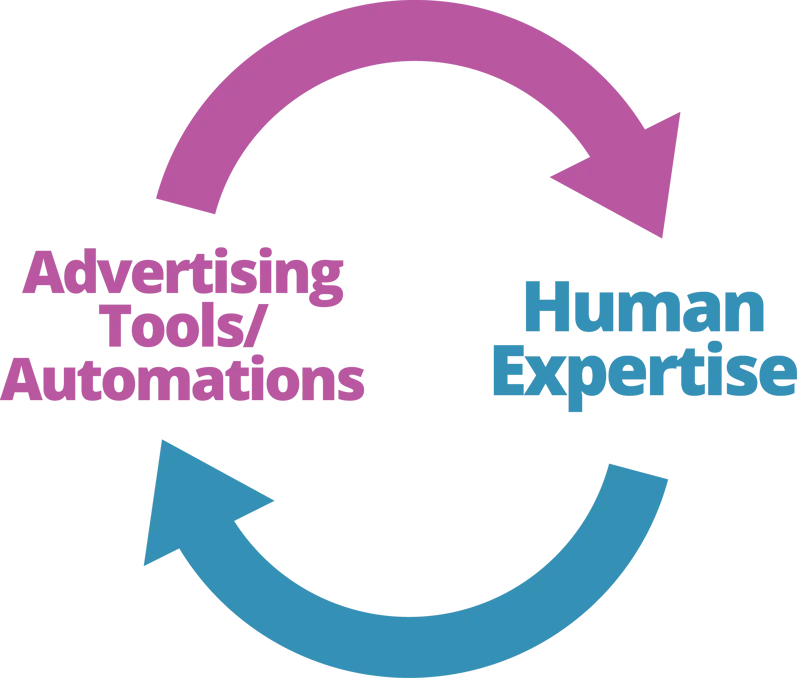
    Your management fee is an investment in expert-driven strategies to deliver results consistently, not just a line item on an invoice. While tools like Google Ads offer advanced automation, such as automatic bidding, they require expert oversight to ensure lead quality and maximize ROI. That’s where our team comes in.


    Here’s what your management fee covers:

    1. Ongoing Campaign Optimization: This isn’t a one-and-done setup; it’s an evolving process requiring human expertise to refine ad copy, targeting, and strategy based on real-time performance.
    2. Data-Driven, Professional Management: Our certified professionals leverage their expertise to monitor and adjust your campaigns, pairing the power of automation with expert judgment for maximum ROI. They use your data—like lead quality ratings and offline sales, which automated campaign tools often can’t access—to make adjustments that will impact your bottom line.
    3. Fresh Creative Insights: The best ad campaigns creatively evolve. Our optimizations include testing multiple ad variations, identifying the most resonant messaging, and creating new ad materials and messaging to enhance results.

    Why does this matter? Machines are powerful, but they can’t replace the insight of the skilled Search Influence marketers who manage your campaigns.

    Ready to optimize your success in 2025? Reach out to your Account Manager today to discuss new digital advertising channels to expand your reach.

  • Cookie Tracking 101 – November Client Insider

    Cookie Tracking 101 – November Client Insider


    Digital advertising targeting is changing, and it’s not as scary as it might sound.

    You may have heard chatter about the “death” or deprecation of third-party cookies. Today’s Client Insider will help you better understand what this means and how it’s changing the world of digital marketing and advertising.

    Background

    For years, browsers have explored suppressing third-party cookie-based tracking on websites. Safari was first, and Google Chrome was expected to follow in 2025. Google, however, announced alternative plans: instead of deprecating third-party cookies, Google Chrome intends to let users make an “informed choice” about how they are tracked (there is no timeline for this).

    The good news: Search Influence and our clients do not rely solely on third-party cookies for targeted advertising or tracking. For example, first-party data collected directly from interactions on a client’s website is a key component of our campaigns. This data is more reliable and privacy-compliant than third-party cookies, allowing for effective conversion tracking within the client’s digital properties.

    We view the phasing out of third-party cookies as an opportunity to adopt more sustainable, privacy-friendly practices that strengthen customer relationships and trust.

    Impact

    Two key elements are affected:

    • Targeting: Advertising platforms can still target some users based on data gathered by cookies, but it will be limited.
    • Conversion Tracking: Tracking conversions in the future will require more client involvement. Your account manager will speak with you about upgrading your conversion tracking as needed.

    To ensure our client campaigns remain effective, Search Influence routinely uses and explores alternative methods for tracking and targeting, such as first-party data, contextual advertising, and browser-based tracking solutions like Google’s yet-to-be-released Privacy Sandbox. See “What’s next?” below for more.

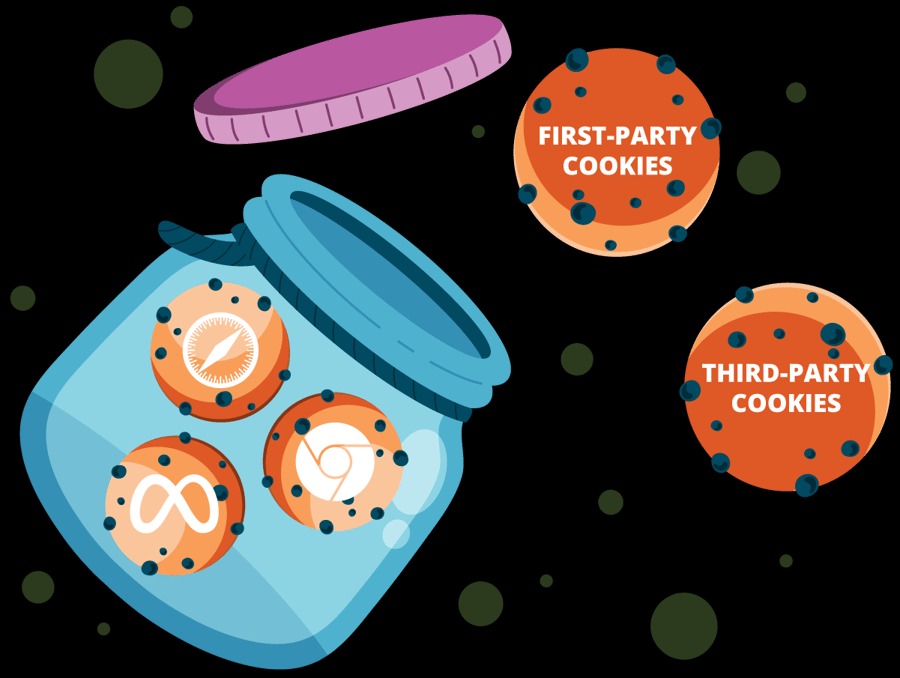
    What’s the difference between first-party cookies and third-party cookies?

    First Party Cookies Third Party Cookies
    What are they? Tracking code that a website owner places on their own site. The website owner receives the data. Tracking code for companies other than the website owner. The data is shared with the third party.
    Examples Google Analytics
    Meta Pixel
    Advertising Conversion Pixels / Tags
    Advertising Networks
    Data Companies
    Meta Pixel (first and third-party cookie)
    How is the data used? Understand your website’s visitors and user behavior; remarket to your website visitors Drive interest-based targeting; understand user interests and behaviors across sites
    Who collects the data? Data is collected by the website you are currently browsing Data is collected by other companies/websites (like ad and data platforms) that track users across multiple websites or devices
    Are these cookies suppressed by browsers? NOT impacted by the deprecation of cookies Impacted by the deprecation of cookies

    What’s next?

    What is Search Influence doing to keep clients’ digital ads effective?

    • Targeting based on first-party data
    • Leveraging other targeting that doesn’t rely on third-party cookies, including contextual targeting, addressable geo-fencing, and campaign audience retargeting
    • Upgrading conversion tracking
    • Staying tuned in to platform updates and adapting quickly as new options are available

    What can you do?

    • Maintain and grant us access to up-to-date CRM records
    • Score your leads so the data can fuel your campaigns to drive more high-quality leads
    • Allow access to our team to set up server-side tracking

    Final thoughts

    This isn’t the first major disruption to ad tech. Platforms will adapt to protect their revenue and provide effective advertising services to businesses.

    Your Search Influence team is also ahead of the curve! In our almost 20 years, we’ve navigated countless industry changes and algorithm updates to serve our clients and meet their goals. Thank you for trusting us to navigate yet another change for you!

    If you want to geek out with us, you can learn more about the details in this blog post.

  • Lights, Camera, Action: Add Video Marketing to Your 2025 Strategy

    Lights, Camera, Action: Add Video Marketing to Your 2025 Strategy

    Transform Your Marketing Strategy With Video in 2025

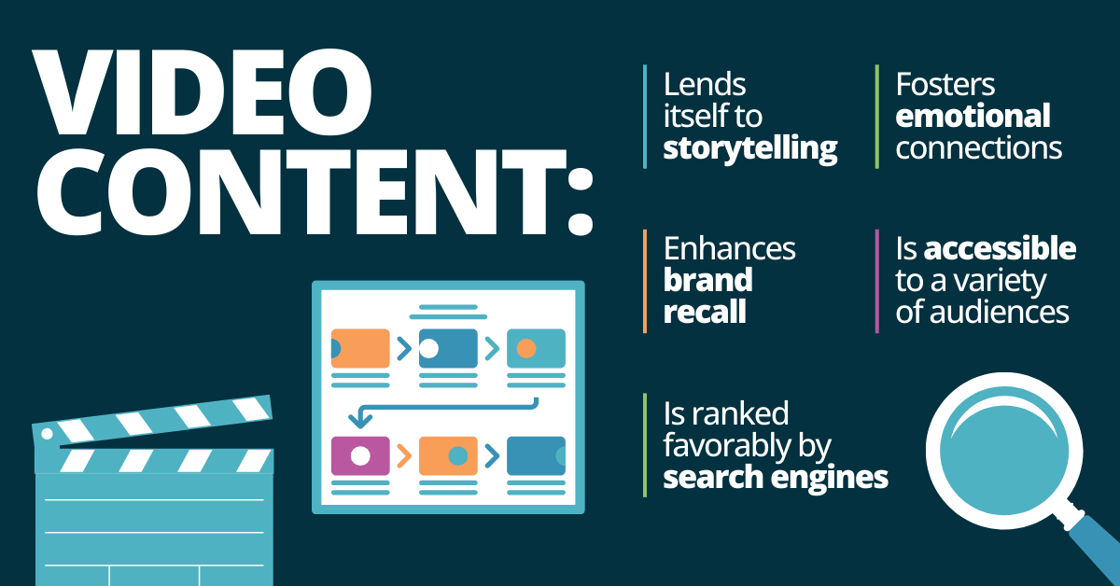
    Video content stands out by fostering connection, enhancing brand recall, and driving action.

    With consumers exposed to an average of 5,000 ads a day — ten times the number from 50 years ago — cutting through the noise demands a more strategic approach than ever. That’s why it’s imperative to incorporate video content into your 2025 marketing strategy.

    Illustrations

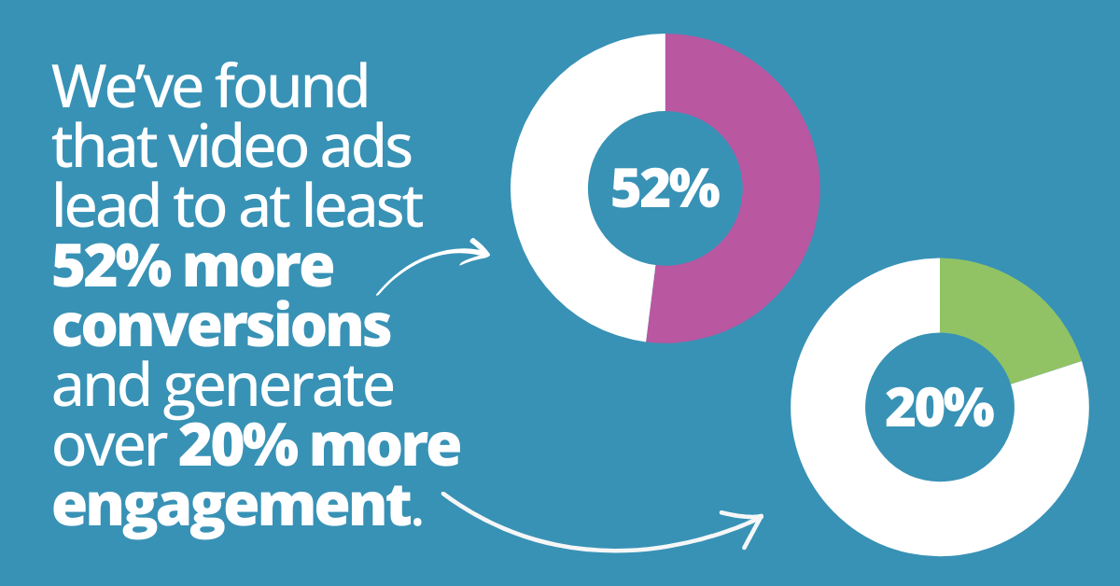
    Videos compel viewers to action more effectively than static image ads. We’ve found that on average, video ads lead to at least 52% more conversions and generate over 20% more engagement.

    While it’s essential on social media — where the share of time US social users spend watching videos will reach 58.2% this year — video is also an impactful content form on display ads, connected TV, and owned channels like websites and email.

    Circle charts

    If you’re hesitant about the time investment required for video marketing, we’re here to help you seamlessly integrate video into your strategy from campaign ideation to execution.

    We offer:

    1. Content Creation:
      From display ads and information montages to testimonial videos, our content captures your audience’s attention.
    2. Production Management:
      We handle all aspects of production, from strategy ideation to managing logistics, including on-site shooting at your location.
    3. Partner Selection:
      We help identify and select the best partners for your project, providing examples of previous work and inspiration to ensure alignment with your vision.

    Learn how we can elevate your 2025 marketing strategy with impactful video content.

    Contact us today to explore our advanced video marketing solutions.

  • How Search Influence Uses AI to Improve Your Ad Results – April Client Insider

    How Search Influence Uses AI to Improve Your Ad Results – April Client Insider

    Unlocking Conversions: Meta and LinkedIn Introduce Advanced AI Targeting

    Discover how predictive audiences and Advantage+ targeting can elevate your advertising campaigns.

    AI for paid campaigns

    New Meta and LinkedIn AI Features Help “Find” Conversions

    As part of our ongoing commitment to optimizing your advertising campaigns, we’re excited to introduce you to the powerful AI features offered by Meta and LinkedIn, designed to help you reach and convert your target audience more effectively.

    Predictive Audiences with LinkedIn Ads

    On LinkedIn, we can leverage predictive audiences, a feature that expands your campaign’s reach by creating an audience predicted to perform actions similar to those within your source data.

    We work with you to curate a list of existing contacts you have that represent the ideal customer – this could be high quality leads or high quality clients/customers. LinkedIn combines your data source and LinkedIn’s AI to automatically generate a new custom audience that has more potential to convert.

    Advantage+ Audiences with Meta Ads

    In addition to LinkedIn, we’re excited to introduce Meta Advantage+ audiences, which harnesses Meta’s advanced AI capabilities to find your audience. (P.S. Meta = Facebook and Instagram.)

    Meta’s AI utilizes a wealth of information including past conversions, pixel data, and interactions with previous ads to continuously refine and evolve your audience targeting. You can rely on Meta’s AI to find your audience, or provide specific information about the people you want to reach. Meta prioritizes audiences matching your suggestions before broadening its search.

    By testing AI-driven targeting in your campaigns, you can expect improved results! We are working these features into our clients’ campaigns where relevant to test their power to drive more conversions within your budget.

    AI has been driving success in your campaigns for years

    Over the years, AI has revolutionized advertising, reshaping how we connect with audiences and optimize campaigns – in Google, Meta, LinkedIn, and programmatic digital advertising.

    AI has evolved to deliver personalized ads, enhancing relevance. Predictive algorithms forecast trends and behaviors, enabling data-driven decision-making, while dynamic creative optimization tailors ad content in real-time to maximize engagement and conversion rates. Now we are testing new audiences created using AI to drive conversions!

    At Search Influence, we continue to adjust our campaign best practices and processes to leverage AI’s potential to drive your advertising success.

    Have questions about AI in your campaigns? Chat with your account manager to understand more!