Author: Shelby Piglia

  • How to Set Up AI Traffic Tracking in GA4

    Key Insights

    • AI platforms are regularly sending real users to websites. This traffic exists today, even if it hasn’t been tracked or discussed widely yet.
    • GA4 doesn’t clearly identify AI-driven visits on its own. Without proper setup, those sessions get grouped with other referrals and are easy to overlook.
    • Visits from AI tools don’t behave the same way as traditional search traffic. They often come from users researching, comparing, or trying to solve a specific problem.
    • Channel-based tracking makes AI traffic easier to find and analyze. Custom channel groups help isolate these visits and keep reporting consistent as AI tools evolve.
    • AI measurement works best when you focus on trends, not perfection. Directional insight is enough to evaluate performance and make smarter decisions.

    Traffic from AI tools is already reaching your website. It’s happening now, and it’s measurable, even if it has never appeared clearly in your reporting. Google’s AI Overviews, ChatGPT, Perplexity, Claude (and so on) are sending users to third-party sites every day.

    The issue isn’t whether AI traffic exists. It’s whether you can see it at all. In Google Analytics 4 (GA4), AI-driven visits are typically classified as Referral traffic, which strips away context and minimizes impact.

    Seeing AI traffic clearly changes how performance is evaluated. Let’s break down how AI traffic shows up in GA4, how to surface it deliberately, and how Search Influence turns those signals into dashboard-level insights that teams can use to make confident decisions.

    What Counts as “AI Traffic” in GA4?

    Before you can track AI referral traffic, you need to be precise about what qualifies. AI traffic isn’t a vague concept or a future trend. It refers to a specific type of visit with a distinct source and intent.

    How AI traffic is defined

    AI traffic includes sessions that originate from AI-powered tools when those tools link users to third-party websites as part of an answer, recommendation, or explanation. These visits happen when a user chooses to leave an AI interface and click through for deeper context, validation, or next steps.
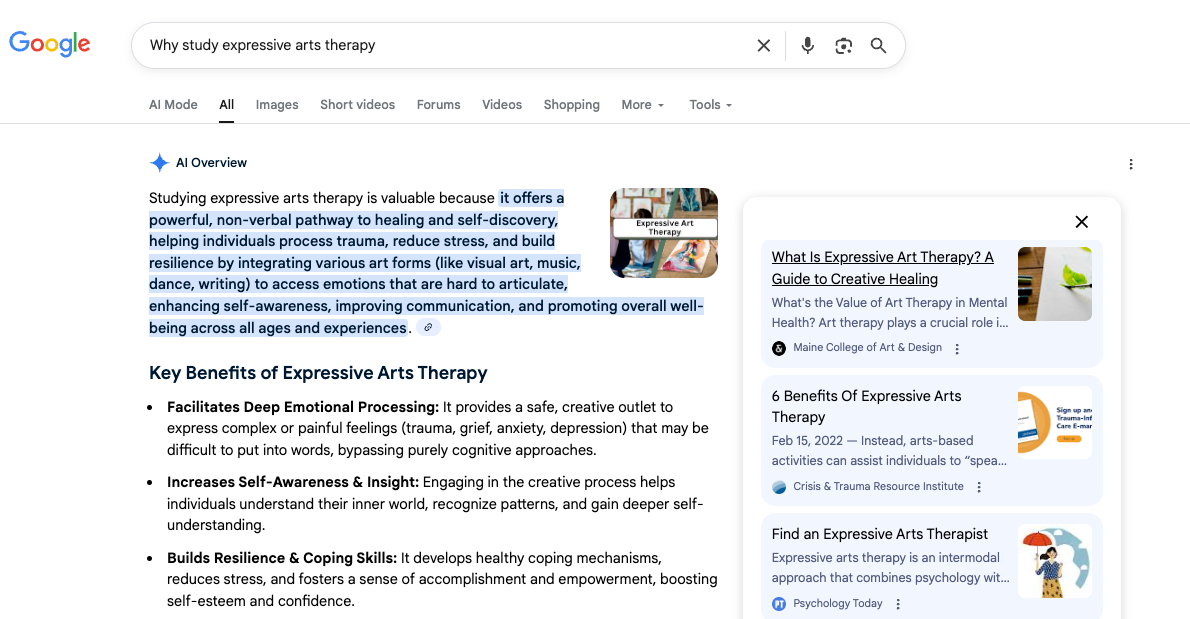
    Pictured: An AI Overview in Google Search showing cited sources alongside the generated response. When a user clicks one of these linked citations to learn more, that visit is sent from the AI interface to the publisher’s website. In GA4, that click-through is classified as AI traffic.

    This type of traffic is already present across many websites. In a 2025 Ahrefs analysis of 3,000 anonymized sites, 63% recorded at least one visit from an AI source.

    Common AI tools that send traffic today include:

    • Google’s AI Overviews
    • ChatGPT
    • Perplexity
    • Claude
    • Gemini
    • Copilot

    If a user clicks a link from one of these platforms and lands on your site, that session counts as AI traffic.

    What AI traffic is not

    AI traffic is often confused with other acquisition channels, which leads to inaccurate assumptions about its role.

    AI traffic is not:

    • Organic search traffic from Google or Bing
    • Paid search or display traffic
    • Standard referrals from publishers, directories, or partners

    Even when AI tools surface content that originally ranked in search, the visit itself does not come from a search engine. The source is the AI platform, not the SERP.

    Why AI-driven visits behave differently

    Users arriving from AI tools typically have a different mindset than traditional search users. In many cases, they are:

    • Researching a specific question or comparison
    • Looking to confirm information they’ve already seen
    • Narrowing options rather than browsing broadly

    As a result, AI-driven sessions often enter deeper into content, focus on fewer pages, and show engagement patterns that don’t always align neatly with organic search benchmarks.

    Why this definition matters

    Without a clear definition of AI traffic, reporting becomes inconsistent fast. Teams end up blending unlike sessions together, misreading intent, or minimizing AI’s contribution altogether.

    Agreeing on what counts as AI traffic makes it possible to:

    • Track it consistently over time
    • Compare it meaningfully against other channels
    • Analyze behavior without muddy attribution

    Once AI traffic is clearly defined, the next challenge becomes visibility (specifically, where this traffic actually shows up inside GA4).

    Where AI Traffic Lives in GA4 by Default

    When AI traffic reaches your site, GA4 has to decide where to put it. That decision happens automatically, based on how GA4 assigns sessions to its Default Channel Groupings.

    GA4 groups traffic by matching source and medium patterns. When a visit doesn’t meet the criteria for search, paid, social, or email, it’s typically assigned to the Referral channel. This is where most AI-driven visits end up.

    Why AI traffic gets classified as Referral

    AI tools send users to websites using standard web links. From GA4’s perspective, there’s nothing about these visits that signals a unique acquisition channel. As a result, traffic from AI platforms is treated the same way as any other external link click.

    That means AI traffic is not labeled, flagged, or separated by default. It’s folded into Referral alongside a wide range of unrelated sources.

    What this looks like in reporting

    In practice, AI traffic blends in with referral sources such as:

    • Software platforms
    • Documentation sites
    • Blogs and media outlets
    • Partner or vendor domains

    Without deliberate segmentation, there’s no clear way to distinguish an AI-driven session from any other referral visit.

    Why this makes AI traffic hard to analyze

    Referral traffic is often reviewed at a high level, if at all. It’s rarely trended with the same attention as organic or paid channels, which makes emerging patterns easy to miss.

    As a result:

    • AI traffic is difficult to isolate over time
    • Growth from AI platforms can go unnoticed
    • AI’s contribution to acquisition and engagement is underrepresented

    AI traffic isn’t invisible in GA4. It’s simply buried, and understanding where it lives by default is the first step toward surfacing it intentionally.

    How AI Traffic Tracking Works in GA4

    Once you know AI traffic is folded into Referral reports by default, the next question is how to surface it consistently. In GA4, that starts with custom AI traffic channel groups.

    Why channel groups work

    Channel groups operate at the acquisition layer in GA4. When AI traffic is defined as its own channel, it becomes visible across standard reports, comparisons, and dashboards without relying on one-off views or manual analysis.

    This approach:

    • Applies consistently to past and future data
    • Integrates cleanly into existing reporting workflows
    • Makes AI traffic comparable to other acquisition channels

    Why filters and ad hoc reports aren’t enough

    Temporary filters and explorations can surface AI traffic, but they don’t scale. They require constant upkeep, fragment reporting, and make trend analysis harder over time.

    Channel groups solve the problem structurally by establishing AI traffic as a distinct acquisition category.

    How AI traffic is identified

    AI traffic is grouped using session source values, not behavior or content signals. When a known AI platform appears as the source, GA4 can assign that session to the appropriate channel.

    This keeps attribution clean and allows rules to evolve as new AI tools emerge.

    A scalable, industry-aligned approach

    Custom channel groups are already a best practice for managing complex acquisition sources in GA4. Applying that same framework to AI traffic creates visibility without overengineering and keeps reporting aligned as AI-driven discovery continues to change.

    High-Level Steps: Setting Up an AI Traffic Channel in GA4

    AI traffic doesn’t need to be created or inferred. It already exists in GA4. The goal of setup is to surface it in a way that’s consistent, durable, and usable across reports.

    1. Create a custom channel group for acquisition analysis
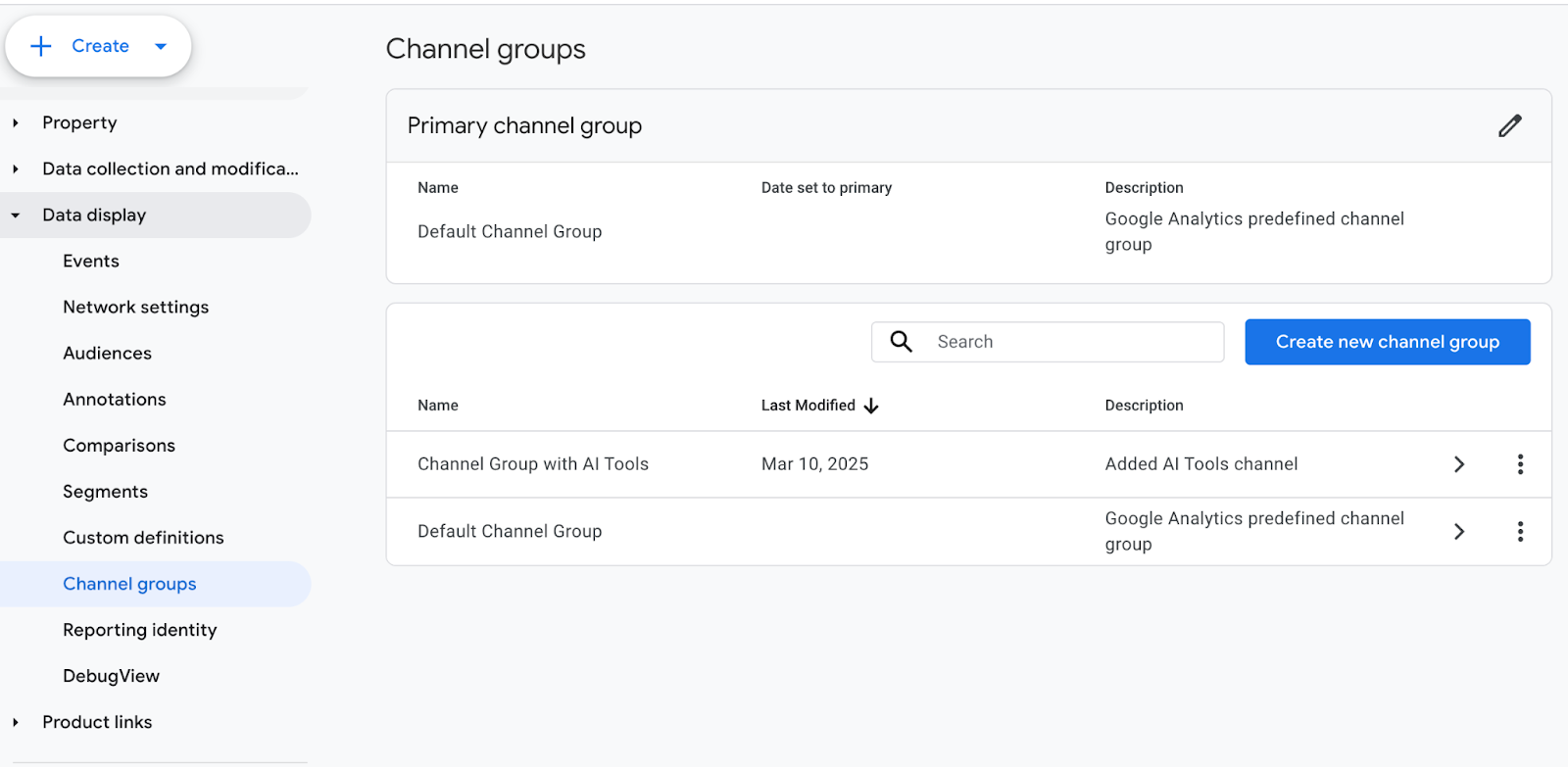
    AI traffic tracking starts with a custom channel group. Channel groups determine how sessions are categorized throughout GA4’s acquisition reporting, which makes them the right layer for isolating AI-driven visits.

    This establishes AI traffic as a first-class acquisition channel.

    2. Add a dedicated channel labeled “AI Tools”

    Within the new channel group, a dedicated channel is defined specifically for AI-driven sessions. A clear label like “AI Tools” keeps reporting readable and reduces ambiguity when data is shared across teams.

    At this stage, simplicity matters more than over-segmentation.

    3. Identify AI traffic using session source values

    As stated above, AI traffic is identified using session source values rather than behavioral or page-level signals. When a session originates from a known AI platform, GA4 can assign it to the AI Tools channel.

    This keeps attribution consistent and avoids guessing user intent.

    4. Apply regex logic to group known AI platforms under one channel

    Known AI platforms are grouped together using pattern-based logic. This allows multiple tools to roll up into a single channel while keeping the structure flexible as AI-driven discovery continues to evolve.

    As new AI tools are released or gain adoption, this regex can be updated to include additional referrers without changing the overall reporting framework. This keeps AI traffic consolidated, prevents fragmentation across referral sources, and ensures visibility keeps pace with the expanding AI ecosystem.

    The channel evolves through periodic refinement, not constant reconfiguration, which makes it sustainable over time.

    5. Reorder channels so AI traffic is evaluated before Referral

    Channel order determines how GA4 assigns sessions. Placing the AI Tools channel above Referral ensures AI-driven visits are captured intentionally rather than falling into the default referral bucket.

    This step prevents AI traffic from being hidden again.

    6. Validate AI traffic visibility in GA4 acquisition reports

    After setup, AI traffic should appear clearly across standard acquisition reports. At that point, teams can begin trending performance, comparing AI traffic against other channels, and incorporating it into regular reporting.
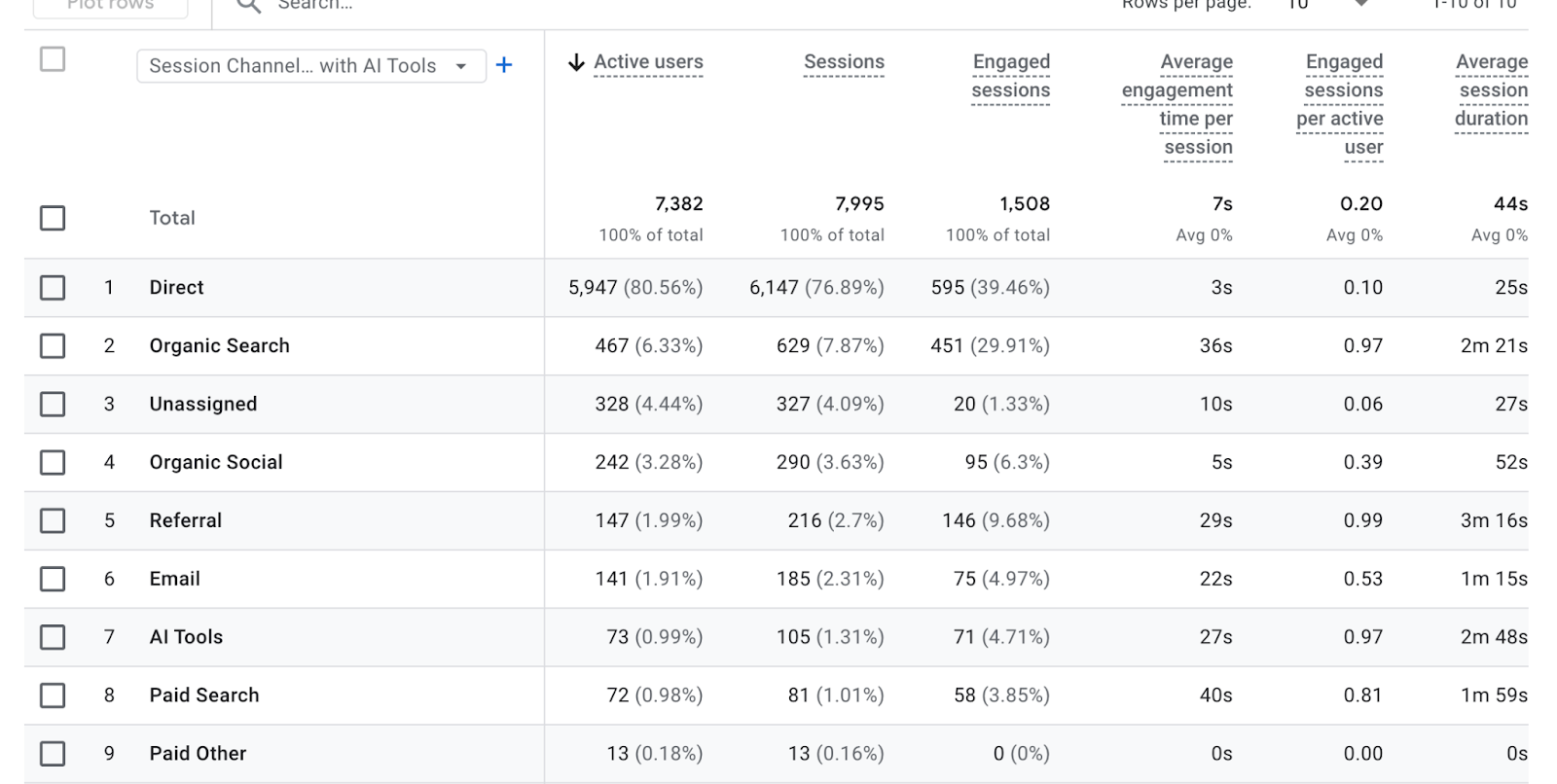
    This setup doesn’t change how GA4 captures data. It simply surfaces AI-driven sessions that were already there, pulling them out of the referral background and into a form that teams can actually use.

    For a more detailed, step-by-step walkthrough of this setup, see Dana DiTomaso’s “How to Track and Report on Traffic from AI Tools (ChatGPT, Perplexity) in GA4.”

    Separating ChatGPT From Other AI Tools

    After AI traffic is surfaced as a channel, some teams notice that one source tends to stand out. In many cases, that source is ChatGPT.

    Why ChatGPT often dominates AI traffic

    ChatGPT often represents a larger share of AI-driven sessions due to its broad adoption (it became the fastest-growing app in history, reaching 100 million active users within two months of launch) and frequent use for explanations, comparisons, and next steps. As a result, it’s often the first AI signal teams notice once tracking is in place.

    How ChatGPT traffic can behave differently

    Not all AI traffic behaves the same. ChatGPT-driven sessions may show different patterns than traffic from tools like Perplexity, Claude, or Gemini.

    Common differences include:

    • Deeper entry points into content
    • Longer engagement on explanatory pages
    • Strong alignment with informational or evaluative intent

    These differences reflect how users interact with various AI tools, rather than their performance quality.

    When separating ChatGPT adds value

    Separating ChatGPT into its own channel can improve clarity when it accounts for a meaningful share of AI traffic or when teams want platform-specific insight. In these cases, segmentation supports analysis rather than adding noise.

    When it’s better to keep AI traffic sources grouped

    For many teams, especially early on, grouping all AI tools under a single channel keeps reporting simpler and trends easier to interpret. Segmentation should be introduced only when it helps answer real questions.

    AI Tool Referrals vs AI-Generated Search Clicks

    AI tools vs AI search features

    AI-driven traffic doesn’t follow a single pattern. One of the most common points of confusion is the difference between AI tool referrals and AI-generated search features.

    AI tools send traffic directly from their own interfaces. When a user clicks a link inside a tool like ChatGPT or Perplexity, that visit arrives as a standard referral session.
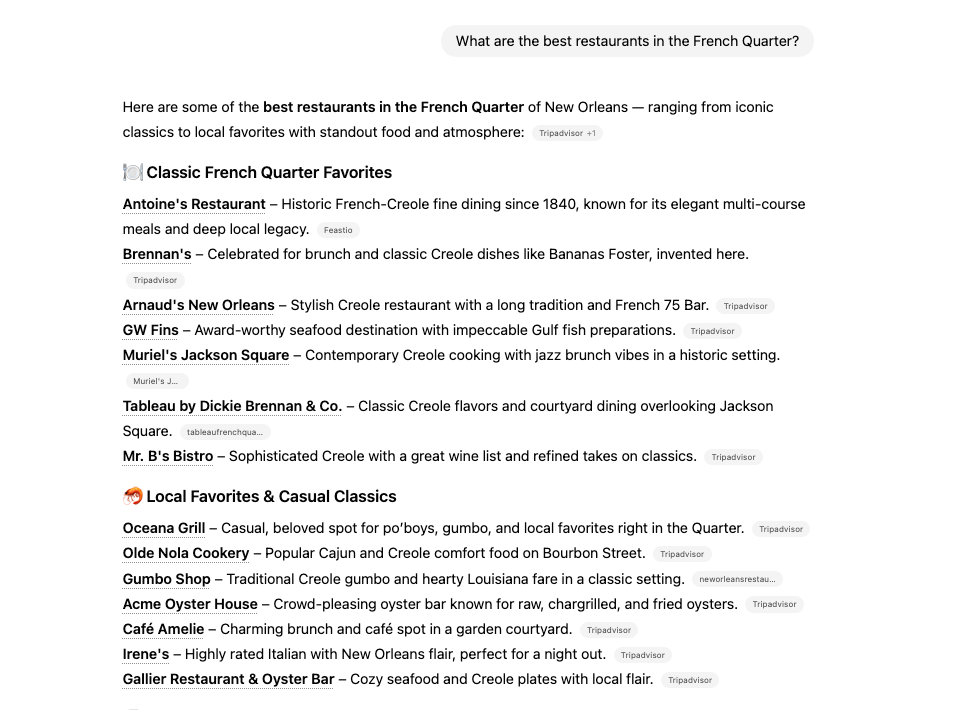
    Pictured: A recommendation list generated inside ChatGPT, where each item includes a clickable external source. When a user selects one of these links and lands on a website, the visit is recorded as a referral from ChatGPT, distinguishing it from clicks that originate within a search engine results page.

    AI-generated search features work differently. These include:

    • AI Overviews
    • Featured Snippets
    • People Also Ask

    In these cases, the user is still on a search engine results page. The click originates from a Google-owned surface, not from an external AI tool.

    Why this distinction matters in GA4

    Because AI tools and AI search features generate different types of URLs, they behave differently in analytics. Channel groups can reliably capture traffic from AI tools because those visits have identifiable external sources.

    AI-generated search clicks, however, often share source and medium values with traditional organic search. As a result, they can’t be isolated cleanly using channel group rules alone.

    Understanding this distinction prevents misreporting. AI tool referrals and AI-generated search features both influence discovery, but they require different tracking approaches inside GA4.

    When Event-Based Tracking Is Needed for AI-Generated Search Links

    Channel-based tracking captures traffic from AI tools, not from AI-generated search features.

    When discovery happens inside AI Overviews, Featured Snippets, or People Also Ask, a different measurement approach is required.

    How event-based tracking fills the gap

    Event-based tracking provides a way to measure clicks from AI-generated search features by identifying specific URL patterns and triggering custom events. This approach typically requires Google Tag Manager and a deeper understanding of how search feature URLs are structured.

    Rather than reclassifying traffic into a new channel, this method captures interactions as events that can be analyzed separately inside GA4.

    What to expect from this approach

    Event-based tracking adds useful context, but it comes with limitations. Teams should go into this with the right expectations:

    • Tracking is partial, not comprehensive
    • URL structures change, which can break rules over time
    • Visibility is directional, not exhaustive

    Because of that, event-based tracking works best as a complement to channel-based AI traffic reporting, not a replacement for it.

    When it’s worth implementing

    This approach is most useful for teams that:

    • Want deeper insight into AI Overviews and other SERP features
    • Have the technical resources to maintain tracking rules
    • Are already comfortable working beyond standard GA4 reports

    For teams looking to explore this layer in more detail, Dana DiTomaso offers a technical deep dive in “How to Track Traffic from AI Overviews, Featured Snippets, or People Also Ask Results in Google Analytics 4”.

    Using GA4 Audiences to Analyze AI Traffic

    Channels show where traffic comes from. Audiences show what users do after they arrive. Once AI traffic is visible as an acquisition channel, audiences become the primary way to understand its quality, intent, and impact.

    How audiences extend AI traffic analysis

    GA4 audiences enable teams to categorize users based on their entry points and subsequent actions. When AI-driven sessions are used as audience criteria, behavior can be analyzed across engagement, conversion, and retention metrics.

    This shifts AI reporting from volume-focused to outcome-focused.

    Common AI-focused audience examples

    Teams often create audiences such as:

    • Users who arrived via AI tools
    • Users who engaged after an AI-driven session
    • Users who converted following AI traffic
    • Returning users whose first session came from an AI source

    Each audience answers a different question about how AI-driven discovery influences performance.

    What audiences reveal that channels can’t

    Channels make AI traffic visible. Audiences make it interpretable.

    With AI-based audiences, teams can evaluate:

    • Engagement depth compared to organic or paid users
    • Conversion rates tied specifically to AI discovery
    • Whether AI traffic introduces net-new users or supports return behavior

    This helps separate curiosity clicks from meaningful acquisition.

    Using audiences to guide reporting and decisions

    AI audiences can be applied across standard GA4 reports, comparisons, and dashboards. Over time, they help teams identify patterns that inform content strategy, UX decisions, and measurement priorities.

    Rather than asking whether AI traffic exists, audiences help answer the more useful question: what that traffic actually contributes.

    What Search Influence Tracks for AI Traffic

    Surfacing AI traffic is only the first step. The real value comes from understanding how that traffic performs, how it changes over time, and how it contributes to broader acquisition and conversion goals.

    Search Influence focuses on a focused set of metrics that balance visibility, behavior, and impact.

    Core AI traffic metrics

    At the foundation, we track AI traffic volume and growth trends over time. This establishes whether AI-driven discovery is increasing, stabilizing, or declining.

    Key metrics include:

    • Total AI sessions and month-over-month change
    • AI traffic share relative to organic search
    • Engagement indicators, such as pages per session and engagement time
    • Conversion performance tied to AI-driven sessions

    These metrics provide directional clarity without overfitting analysis to short-term fluctuations.

    Understanding performance by AI tool

    Beyond aggregate volume, we break AI traffic down by platform to understand how different tools contribute to discovery and engagement.

    This includes:

    • Traffic distribution by AI channel
    • Engagement and conversion behavior by tool
    • Early identification of new or emerging AI referrers

    Comparing tools side by side helps teams spot meaningful differences without assuming all AI traffic behaves the same way.

    Visualizing AI Traffic With Custom Dashboards

    Why GA4 alone isn’t enough

    GA4 can store the data, but it’s not built for fast, repeatable AI reporting across a team. Most AI questions require clicking through multiple reports, changing dimensions, and rebuilding the same views every time.

    Common friction points include:

    • AI traffic gets buried unless you know exactly where to look
    • Views are hard to standardize across stakeholders
    • Trend checks take too long to repeat weekly or monthly
    • Non-analysts struggle to pull the same story consistently

    If AI visibility matters, reporting has to be easy to access, easy to trust, and easy to repeat.

    How Search Influence dashboards surface AI insights

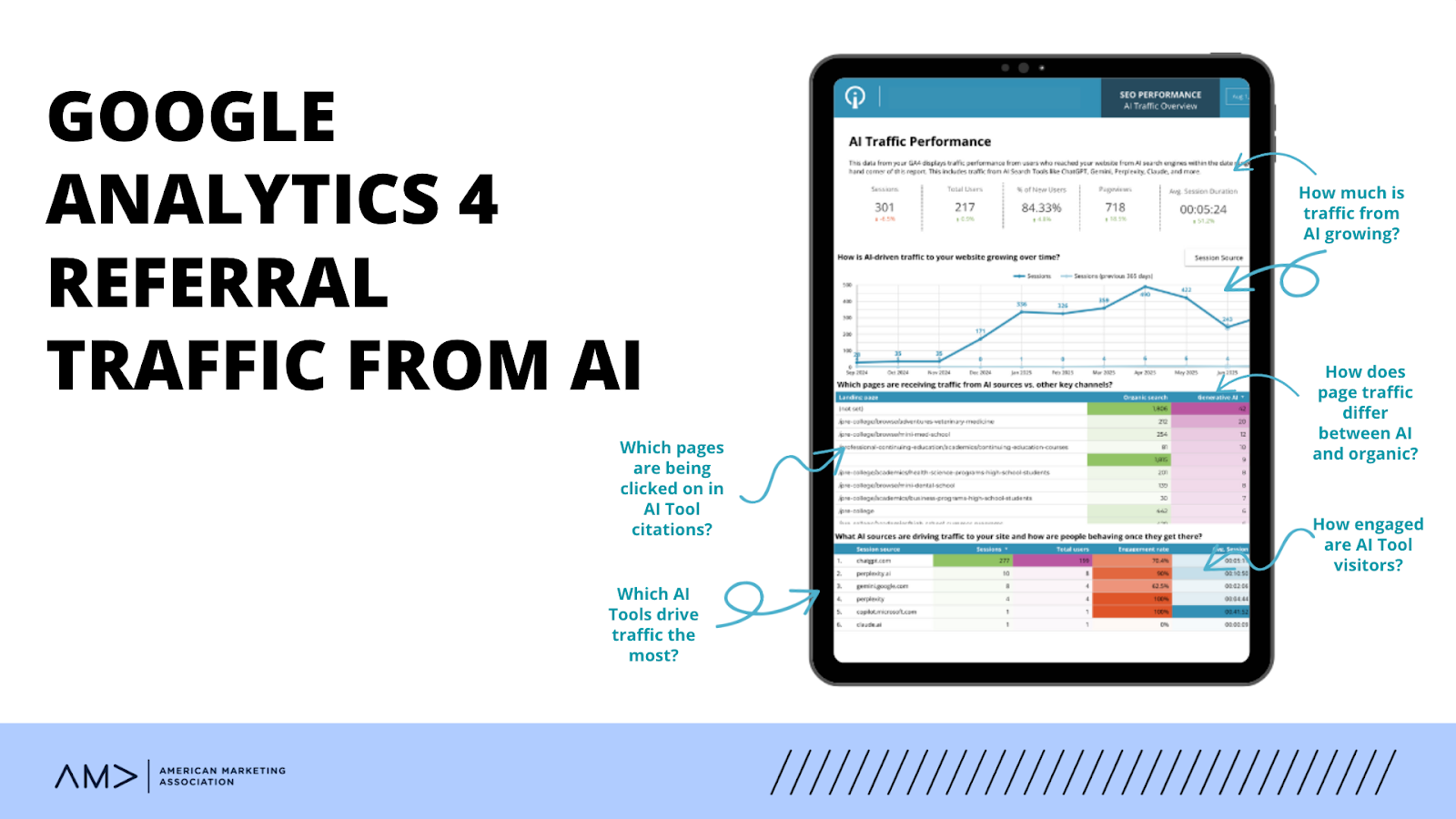
    Dashboards translate AI tracking into a shared, repeatable view that teams can rely on. Instead of rebuilding reports, AI performance is surfaced alongside organic and paid channels in a consistent format.

    Our custom-built dashboards typically show:

    • AI session volume and trend movement over time
    • AI traffic share relative to organic and paid
    • Engagement and conversion behavior from AI-driven sessions
    • Platform-level detail when it supports analysis (e.g., ChatGPT vs other tools)

    This shifts AI reporting from exploration to execution, making it part of an ongoing performance review rather than a one-off analysis.
    AI Tracking Tools Beyond GA4

    While GA4 remains the foundation for measuring what happens on your site, other platforms are beginning to surface how brands appear across AI-driven experiences.

    Today, these tools generally fall into three roles:

    • AI visibility tracking tools (such as Scrunch)
      Help teams understand where and how a brand shows up inside generative AI tools, including citation patterns and brand presence.
    • SEO platforms expanding into AI signals (including SEMrush and Ahrefs)
      Provide early indicators around AI citations, content reuse, and discovery, often alongside traditional search performance.
    • GA4 as the system of record
      Confirms what AI-driven discovery actually produces once users arrive, including engagement, conversion behavior, and downstream impact.

    Together, these tools answer different questions. Visibility platforms show where discovery happens. SEO tools reveal how content is reused or cited. GA4 validates what that traffic does next.

    The Reality of AI Traffic Tracking Today

    AI traffic tracking is not static. Referrers change, AI interfaces evolve, and attribution rules shift over time. Precision at the session level will never be perfect.

    What matters is consistency.

    When AI traffic is tracked the same way over time in GA4, patterns become visible. Teams can evaluate momentum, engagement quality, and contribution alongside other channels, even as the ecosystem changes.

    The goal is a usable signal, not a flawless measurement.

    FAQs

    1. Can GA4 automatically identify AI traffic without configuration?

    No. GA4 does not currently recognize AI-driven visits as a distinct channel on its own. By default, traffic from AI tools is classified as Referral, which makes it difficult to identify or analyze without additional setup. Custom channel groups are required to surface AI traffic consistently.

    2. Is AI traffic replacing or supplementing organic search traffic?

    At this stage, AI traffic is best understood as a supplement, not a replacement. Most AI-driven visits reflect users researching, validating, or comparing information before taking action. These behaviors often overlap with search intent, but they represent a different discovery path rather than a direct substitute for organic search.

    3. How accurate is AI traffic tracking in GA4 today?

    AI traffic tracking in GA4 is directional rather than exact. Known AI referrers can be reliably grouped using session source values, but attribution is not perfect and will evolve as AI tools change. The goal is consistent trend visibility over time, not precise session-level certainty.

    4. When should AI traffic be reported separately from organic traffic?

    AI traffic should be reported separately once it reaches a volume or strategic relevance that affects analysis or decision-making. Separating it too early can add noise, but grouping it indefinitely can hide meaningful patterns. The right timing depends on scale, stakeholder questions, and reporting needs.

    5. How often should AI tracking rules and definitions be reviewed?

    AI tracking rules should be reviewed periodically, typically quarterly or when major AI platforms introduce changes. New tools, referrer behaviors, and interface updates can affect how traffic appears in GA4. Regular review helps ensure definitions stay accurate without requiring constant adjustment.

    Turning AI Visibility Into Actionable Insight

    AI-driven discovery is already shaping how users find, evaluate, and engage with content. When tracked intentionally, it provides clear signals that strengthen SEO strategies, content decisions, and performance reporting.

    Search Influence brings structure to this complexity through proven tracking frameworks, executive-ready dashboards, and analytics that teams can act on with confidence.

    To gain clear visibility into how AI traffic is impacting your site, get in touch to explore our SEO, reporting, and analytics support.

    This post is informed by analytics frameworks and methodologies shared publicly by Dana DiTomaso. Our approach builds on those foundational concepts, adapted to how Search Influence configures reporting, analyzes performance, and delivers AI traffic insights through custom dashboards for our clients.


  • Increase Conversion Rates and Improve Rankings with a Mobile-Optimized Website

    Key Insights:

    • A mobile-optimized website can make or break a business since a bad mobile user experience can result in a loss of leads and conversions.
    • With more than half of site visitors coming to sites through mobile, your mobile site must have a positive user experience.
    • A positive user experience revolves around how easily a user can navigate a site and complete their goal.
    • Google expects your mobile experience to be just as good, if not better, than desktop.
    • Ensure a positive user experience for mobile users through site speed, ease of use, and similarity to desktop experience.

    In this digital age, it’s standard that people access the internet on their mobile devices vs. a desktop computer. A mobile-optimized website can make or break a business since a bad mobile user experience can result in a loss of leads and conversions. This post will talk about what a positive mobile experience entails and why it’s so important for businesses today.

    A smart phone sitting on a table

    Why is the Mobile Experience Important?

    A bad mobile user experience hurts lead conversions and the overall perception of your company and service.

    According to recent studies, over half of internet visits in 2017 originated from a mobile device. As of August 2021, that number has moved to 56.75%. With over half of website visits coming from mobile, your website should accommodate those users. And, with over 53% of users only willing to wait 3 seconds for a mobile page to load before abandoning the page, it’s essential to make sure that the user experience of your mobile site is optimal.

    A positive mobile user experience helps retain leads that come to your site from mobile devices and increases the likelihood they convert. A user navigates to your site with a goal. If they aren’t able to complete that goal with ease from their phone, they won’t continue to use your site and service—meaning, they won’t convert.

    Additionally, Google has stated they use a mobile-first ranking strategy. This means that before they check the desktop version of your site, they look at the quality, effectiveness, and user-friendly aspects of your mobile site to determine your ranking within the search engine.

    You can check out Google’s mobile-first indexing best practices here. Some key takeaways:

    • Google expects a positive mobile experience and checks on this by making sure your desktop and mobile versions of your site are virtually the same
    • Google verifies your site makes good use of structured data
    • Your site has fast load times.

    Google provides Mobile-Friendly Testing Tool you can use to indicate whether Google finds a page on your site mobile friendly.

    A positive mobile experience impacts the perception of your business. With almost everyone on a mobile device and accustomed to certain standards of the digital world, a bad mobile experience leaves the wrong impression. A user might think, “Maybe if this business isn’t ‘with the times’ and able to provide a good mobile experience, what else can’t they do for me?”

    A smart phone and tablet on a table

    3 Components of a Strong Mobile Website Experience

    Positive Browsing Experience

    A positive user experience hinges on a user’s ability to navigate a site with ease. In a mobile context, this means a user can navigate the pages of the site to accomplish their goal without having to put in too much thought on how to do so.

    The site navigation needs to be easy to find and easy to use. For example, if you have a lot of pages and the menu expands so long when clicked that a user can’t easily click on the pages they need, that results in a negative user experience.

    Another example could be looked at in the scope of e-commerce:

    • Can the user easily access the cart?
    • Can a user easily and intuitively add and remove items from their cart?

    Your mobile site should make it so that the user doesn’t have to think about what they need to do; they can just complete the actions they need with ease.

    Clear and easily clickable calls-to-actions benefits users when navigating around a site and completing actions. If a user can’t accomplish their goal easily, it will likely result in a lost lead and conversion.

    Site Speed

    Users and Google value site speed. Users are not willing to wait around forever for a page to load. This case is even more true on a mobile device. If you picture why someone might be using mobile over desktop, it very well might be that they are on the go. A user in the middle of something, needing to be able to accomplish a goal quickly, is even less likely to wait for a page that’s taking too long to load completely.

    The Mobile Experience Mirrors the Desktop Experience

    As outlined in its best practices, Google expects your mobile experience to mirror your desktop experience. All the same tasks a user can do on your site on a desktop should be as easily accomplished on mobile. For example, a user should have as easy of a time scheduling an appointment on the mobile version of your site as they could on a desktop.

    With so many visitors coming to sites on mobile, it’s imperative that your site follows good mobile user experience best practices. This will help with lead generation and with search engine rankings. Not sure where to start? Reach out today and talk to us about conducting a user experience audit for your site.

    Images:

    Smart phone

    Smart phone and tablet

  • What You Need to Know About Website Accessibility

    Key Insights

    • Every business is required to implement certain accessibility standards on their websites, not just major corporations
    • An accessible website ensures that people with disabilities can seamlessly use it
    • Many SEO best practices are also a part of website accessibility guidelines

    Introduction

    Having a website that follows accessibility guidelines is increasingly important for businesses. It’s imperative to have a website that is functional for people with disabilities to service that demographic of consumers; it’s also the law. Every business is required to implement certain accessibility standards on their websites, not just major corporations. In 2019, there were over 2,000 lawsuits over website accessibility compliance.

    An accessible website ensures that people with disabilities can seamlessly use your website to browse and buy your goods and services. In this post, we’ll define what it means for your site to be accessible, how it impacts your business, and provide you with examples and best practices.

    Person using a screen reader to browse internet

    What Does It Mean to Have an “Accessible” Website?

    Having an accessible website means implementing usability features to support the 110 million to 190 million adults who have significant disabilities. Disabilities vary widely, and it can feel overwhelming to consider how to serve this entire audience. You can start by viewing the Americans With Disabilities Act (ADA) and Web Content Accessibility Guidelines (WCAG).

    Why Should You Have an Accessible Website?

    Making your website accessible is a win-win situation for users and businesses. Consumers can find the services they need, and you can provide them the services they want.

    Requiring website accessibility is a huge step in limiting frustration and difficulty for people with disabilities. Imagine all of the different ways that you use the Internet on a daily basis. Now imagine it again, but this time being unable to use many of the websites you want.

    Businesses of all sizes run the risk of encountering lawsuits if they do not have an accessible website. Large corporations such as Domino’s have been sued for not following accessibility standards. Common industries most impacted by web accessibility lawsuits:

    • eCommerce sites that host transactions
    • Organizations that offer services:
      • Law firms
      • Medical facilities
      • Schools

    What Are the Key Points of the Web Content Accessibility Guidelines (WCAG)?

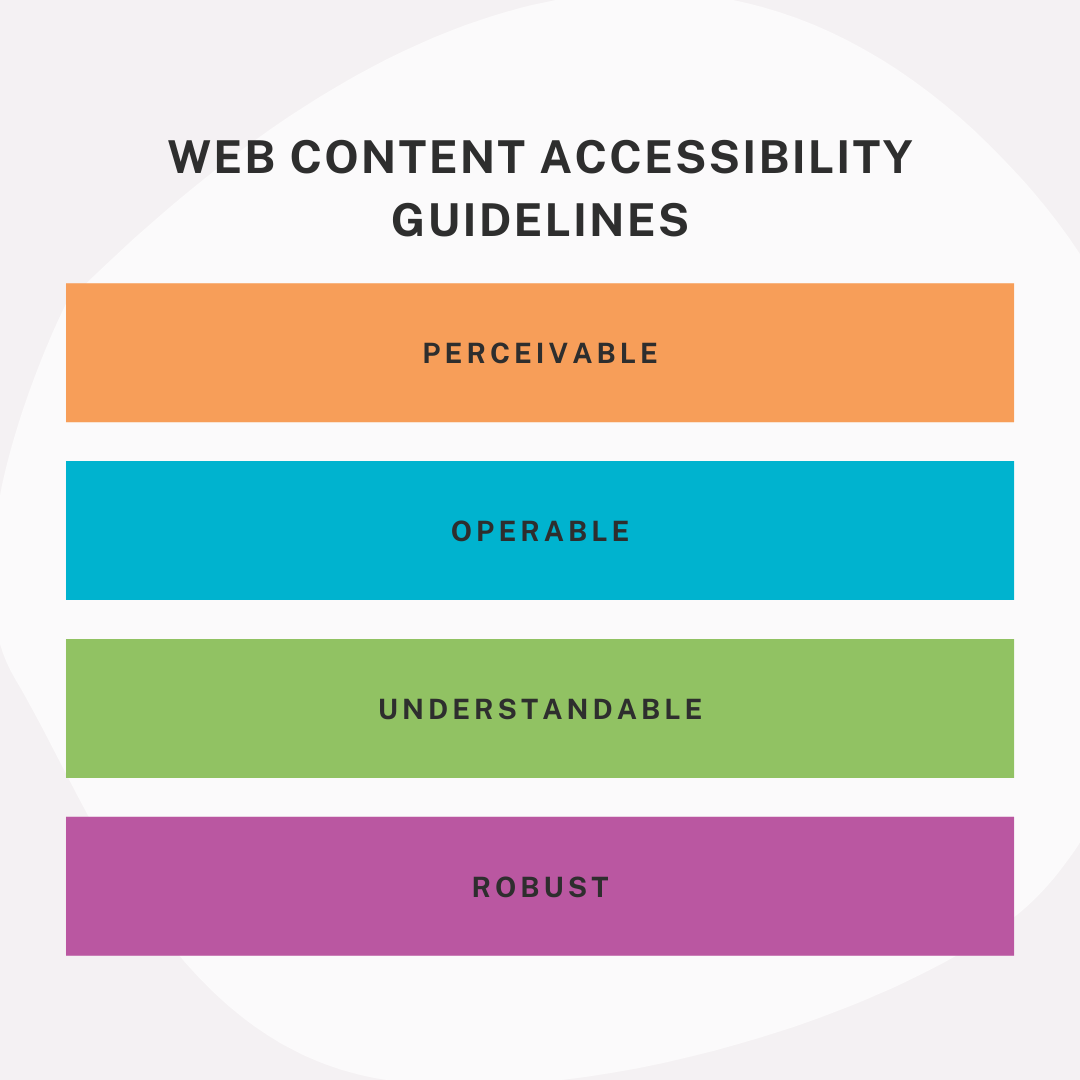
    Web content accessbility guidelines, perceivable, operable, understandable, robust

    The WCAG covers a wide range of ways to make your website accessible to individuals with disabilities. Use their checklist to start making your website accessible to all types of users who seek your services.

    Guideline categories:

    • Perceivable: Information and user interface components must able to be perceived by users
    • Operable: Users must be able to operate user components and navigate the website
    • Understandable: Information and user components must be able to be understood
    • Robust: Content must able to be interpreted by a variety of users, including assistive technologies

    Each section further outlines how you can accomplish these goals. For example, under the Perceivable category, sites are required to have alternative text for their images so that a person with a visual impairment who uses a screen reader could have the image described to them.

    What Are the Levels of “ADA Compliance”?

    The WCAG has varying levels of compliance for websites. Here’s a brief rundown:

    • A: Lowest level—Includes some accessibility features, but often doesn’t have enough to satisfy all users and situations.
    • AA: Mid-range level—Recommended because it satisfies many requirements and makes sites accessible in most situations. The goal should be to make your website AA compliant at the minimum.
    • AAA: Highest level—Requires many specific features that may not be possible to set up in some scenarios, which is why it isn’t used as the standard. Implementing the AAA features may even require a dedicated staff member to keep up with the latest guidelines and maintain AAA compliance.

    How to Make Your Website Accessible

    It’s important to start from the beginning. How complicated will it be to make your website accessible will come down to how your website was built. Things as simple as whether your website was built to support alternative text on images can be make or break. If you’re looking to upgrade your website sometime soon, make sure to use best practices for website accessibility right from the start.

    If that’s not the case, there are many things you can do to make your website accessible. Even paying close attention to your site’s SEO can make a huge difference. Alternative text, for example. Alternative text is recommended for SEO for multiple reasons one being that images show up in image search results. But, it’s also recommended for website accessibility. Many SEO best practices are also a part of website accessibility guidelines, so it’s a great place to start.

    There are lots of great tools you can use as a quick, easy solution to automate the process of making your website. However, it is important to research the tools you pick and make sure that they will make your site at least AA compliant. If not, consider what additional work you may need to do once the tool has done some of the work.

    Website accessibility should be a priority for your business because it benefits you and the users visiting your site. Your business benefits from clients who may have been lost if your website was not compliant, and it limits your exposure to accessibility lawsuits. Users with disabilities benefit because they can find and use your services more comfortably. You can start by reviewing accessibility guidelines. Here’s an introductory tool we created.

    Reach out to one of the experts here at Search Influence today to see what we can do to help you get started on your path to accessibility! Contact us today to learn more.

    Images

    Screen reader


  • How Does Having an SSL Certificate Impact Your Site’s SEO?

    Site security and user privacy have been a hot topic in the technological community lately. With big names like Google pushing for tighter security, it leaves website owners wondering what they need to do to ensure that their site is compliant with the best practices that will ultimately lead to them being favored in search results. One of the security measures that’s being pushed is ensuring that a site is secure. But what is a secure site and why does it matter? Here’s what you need to know about SSL Certificates and the role they play in your site’s SEO.

    Graphic of lock laid over an map of the world

    What Is an SSL Certificate and How Do I Get One?

    A Secure Sockets Layer Certificate is a means of creating an encrypted connection between a web browser and server. By using an SSL Certificate, an encrypted key protects sensitive information that is submitted by site visitors. If you’ve really got internet security on your mind, you can dig deeper by taking a more technical look at SSL Certificates.

    There are paid and free versions of SSL certificates, and others may be included through your hosting service. Depending on your CMS and hosting provider, there are various ways to get your virtual hands on a certificate. For example, installing a WordPress plugin or rerouting your site through CloudFlare may be an easy and convenient option. If neither of these are possible or ideal, you can usually purchase one through your hosting provider or buy one somewhere else and install it manually.

    Once you have it installed, it’s equally important to ensure that you keep your certificate up to date by auto-renewing it or making sure to renew it before the expiration date.

    What Does an SSL Certificate Mean for Your Site and Its Visitors?

    Which site would you rather make a purchase on: One with a red “Not Secure” warning clearly visible, or one boasting a green padlock ensuring that all of your information stays secure?

    Super hero sweating whether to pick secure or non secure options

    It’s a no-brainer. Secure sites are more appealing to visitors because they are provided the comfort of knowing that any of their information that is passed onto the server will be encrypted. Enhancing user experience should be a top priority for your website. A site with a “Not Secure” warning may even scare off some visitors from completing any transactions or creating an account on your site. Installing an SSL certificate and having a fully secure site means that your site and its visitors can have peace of mind.

    Do You Have to Have an SSL Certificate?

    Technically, no—at least not yet. However, browsers are now making their users more and more aware of which sites are secure and which ones are not. For example, Google’s push for secure sites includes making the “Not Secure” warning more prominent on web pages, as well as favoring secure sites in search results. Some sites that aren’t secure even direct the user to a full warning page warning them not to continue before they can click through to the site. This definitely won’t help a site’s bounce rate.

    Additionally, if your site’s connection isn’t secure, it leaves your users’ information vulnerable to people looking to get their grubby hands on it. Personally, I wouldn’t want to be the person sending the email to users letting them know their information has been compromised should the worst happen. Why not make your site secure and provide your users with the assurance they need before willingly giving you their information? Overall, having a secure site greatly enhances user experience, confidence, and the overall trust of your brand. If that wasn’t enough, whether or not you have an SSL Certificate can impact your SEO and search engine rankings.

    What Does SSL Have to Do With SEO?

    Having an SSL Certificate on your site is becoming more important than ever for SEO and search result rankings, and its significance will only increase. Search engines are rewarding sites that are secure and penalizing those that are not. According to an article by Neil Patel, data shows that sites with an SSL Certificate are getting increased traffic over those that don’t. Plus, as Google continues to place an increased emphasis on the importance of SSL, it will likely have an even bigger impact on SEO rankings as the years progress.

    Much like Google’s push to require mobile-friendly sites for healthy SEO, a secure site is going to become the standard. If your site isn’t secure, then not only are you behind the times, but you are no longer following best practices. Many platforms that outline what your site does well and what needs to be improved will start to report that your site being not secure is an issue, if they don’t already.

    Graphic of SSL certificate being displayed in browser's URL field

    Making your site secure will let you take advantage of all of the current and future benefits that come with it. Now that you understand what an SSL Certificate is, how to get one, and why it’s crucial for your site, its visitors, and your SEO, contact Search Influence to make your site secure and enhance your SEO.

    Images

    Map Lock

    Secure vs. Non Secure

    Browser

  • What Is Domain Authority & Why Does It Matter?

    Computer screen displaying domain authority metrics at Search Influence in New Orleans, LA

    Your website has been live for some time. You’re past the development stage, so now you’re starting to think about the nitty gritty side of its performance. What does Google think of your content? Are your pages valuable? Why is your site ranking below competitors in search results?

    Your website’s domain authority score can help answer these questions and provide valuable insight. But what exactly is domain authority and how can you utilize it to grow the number of visitors to your site?

    What Is Domain Authority?

    Domain Authority (DA) is a score given to your domain based on an algorithm developed by the SEO company, Moz. It is a projected numerical value of how well a site will rank in search engine results. The algorithm to determine Domain Authority takes into consideration link profiles (a list of all your website’s backlinks), content quality, SEO best practices, and more. Just as Google and other search engines must measure various front and back-end site features when fetching up search results, DA scoring tools also take numerous factors into consideration.

    But, what is a good domain authority score? Domain authority is relative—there is no ideal DA score. Ultimately, you want your authority to be higher than that of your competitors. There is so much variation in search results that it would be difficult to say a higher DA will lead to better results versus a competitor; however, it is a good indicator that you are utilizing sound digital marketing techniques and providing high-quality content for your industry.

    Additionally, there are tools that measure domain authority using different metrics than Moz, such as Ahrefs or SEMRush. In many cases, the DA measured by these tools is significantly different on a 1-100 scale and varies from tool to tool. Measuring DA requires a degree of relativity to the other results within that tool. Google claims it does not acknowledge or recognize domain authority score when serving up search results. The score is just an estimation based on several different factors of how well you will rank. As is common in the digital marketing industry, Moz announced a recent update to their process. They will release changes to their Domain Authority score calculations in early March. Algorithm changes can impact your score because it may change what Moz thinks is valuable about your domain. While the things being calculated in these scores may not directly correspond to how search engines are ranking your pages, there is still value in knowing your domain score.

    How Do I Check for Domain Authority?

    Now that you understand a little bit more about what a domain authority score is, how do you find yours? There are several tools available that provide you with your score and how your score ranks up among your competitors.

    Ahrefs

    This effective tool can provide extensive information about your domain’s authority score, as well as other insights into how your score is being calculated. With a paid subscription, you can see your DA score along with other statistics, like the number of healthy backlinks you have and how your organic traffic is doing. It will even show you how many points your score has gone up or down on a daily basis if there are any changes.

    Moz

    The originator of the DA score, Moz, offers a free Chrome extension, MozBar, to measure your Domain Authority. Subscription to a Moz Pro account gives you access to SEO campaign monitoring, as well as tools that can help increase your Domain Authority score overall.

    SEMRush

    Another leader in SEO tools for sites, SEMRush is a great option when monitoring your domain authority. Not only does it allow you to keep up with your DA score, but you can also use it to complete competitive research between you and your competitors.

    These are just a few of the top tools you can use, but you may still be wondering why you should even bother checking your domain authority.

    Domain authority metrics displayed across three laptop screens at Search Influence in New Orleans, LA

    Why Does My Domain Authority Matter?

    Knowing your DA score can help improve your overall domain value in search engines. Having a higher DA means that you are predicted to be higher in the search results than domains with a lower score. It can be a good benchmark on your site’s SEO and the value of information present on your site. If you have a lower domain score compared to your competitors, then it might be time to start searching for strategies to increase your score.

    How Do I Increase My Domain Authority?

    Since so many factors go into the calculation of your DA, there are a variety of areas you can focus on. Here are some of the few more valuable points:

    Building Strong Backlinks

    Backlinks are arguably one of the most important contributors to high domain authority. What we are talking about here are quality backlinks. For a quick refresher of backlinks and their value, check out our previous blog post. Backlinks coming from other sites with high authorities shows that you are also a reliable source of valuable content and information. By acquiring a multitude of quality backlinks, you are in turn raising your own authority. This also has the opposite effect if you acquire backlinks that are not high quality. It is important to note that Moz has updated their algorithm to devalue purchased links. In the past, people have tried selling links from sites that claim to have high domain authorities to sites looking to boost their own domain authority. However, this will no longer be beneficial; in fact, it could be harmful to a site’s domain authority. Getting backlinks from sites that can be considered spammy in turn tell the algorithms that your site might be spammy as well. It is crucial to your site’s health to disavow bad backlinks in Google Search Console with this tool.

    Having Useful and Valuable Content

    People use search engines to find information; so, if your website provides valuable content that answers people’s questions or provides them with the knowledge they are looking for, your authority will be higher. A valuable threshold for content quality is Google’s E.A.T. guidelines—expertise, authoritativeness, and trustworthiness—so make sure your content hits these marks.

    Using Overall SEO Best Practices

    Engaging in Search Engine Optimization makes your content—therefore, your site—more easily accessible and reliable to search engines’ algorithms. Your site is more likely to have a higher domain score and display higher in the Search Engine Results Page (SERP) if your content is more accessible to search engines. Learning more about SEO best practices and how to implement them can not only be immensely beneficial for your domain authority but also for your site’s traffic overall.

    All in all, even if Google doesn’t calculate the domain authority of a site, it can still be a powerful estimation of how meaningful and reliable Google thinks the content on your site is. If you have a higher score than your competitors, then likelihood of you outranking them in the SERPs is pretty high. Working to increase your site’s DA authority can have plenty of positive SEO benefits. Still feel confused or overwhelmed? Request a free analysis from Search Influence to see how we can monitor your domain authority and help steadily increase it with a customized SEO strategy for your business.

    Images:

    Computer Screen With Metrics