Author: Katie Burke

  • How Hospitals and Healthcare Practices Can Adapt to Google Updates

    Key Insights

    • Google decides what websites show as local and organic results by considering the business and it’s website’s relevance, prominence, and distance.
    • Keywords, content, and connections continue to be required to earn trust with google and keep your website relevant. However, the WAY you think about keywords or the WAY you write content may need to adapt over time to Google’s changes.
    • Google trusts up-to-date, accurate, and user-friendly content.

    Google is continuously updating their algorithms. These changes are usually small, but now and then, a significant update affects the way marketers have to approach search engine optimizations. It’s crucial for marketers in the medical industry to promptly adjust to these updates because Google has additional regulations for healthcare websites.
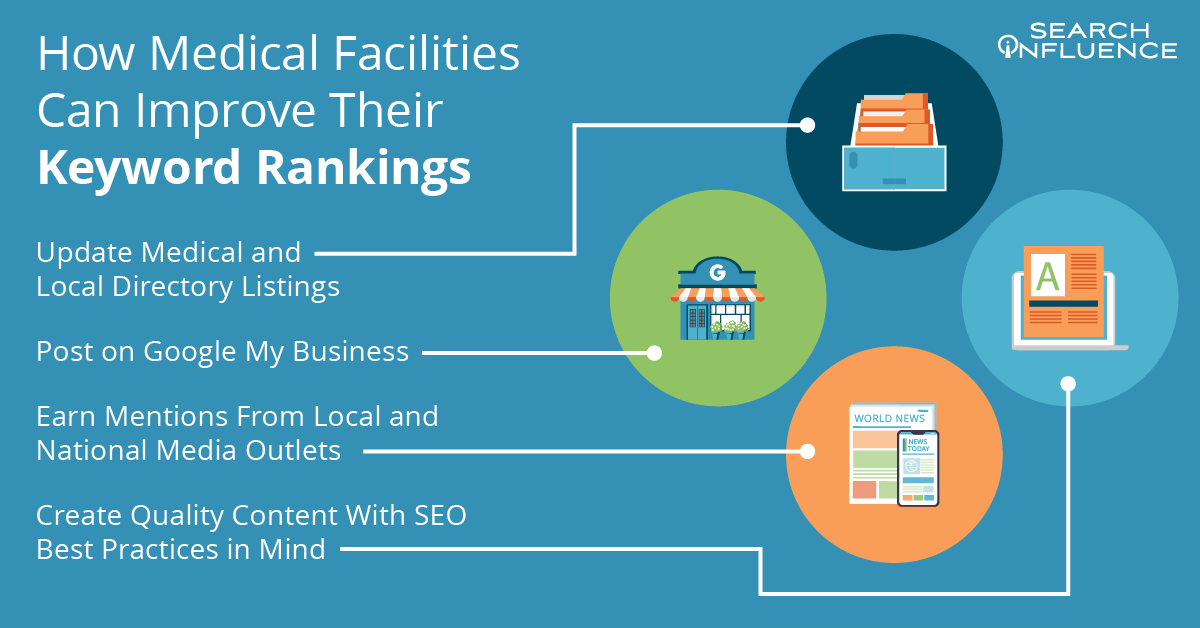
    How medical facilities can improve their keyword rankings

    The Basics of Google Search and SEO

    Before diving into the algorithm updates, medical practices should understand a few optimization basics. Before a user searches for a keyword, Google has already analyzed and organized information from millions of webpages in its Search Index. When a search begins, Google’s algorithms sort through the index using hundreds of different factors to find relevant results. These results are then displayed in different formats so that people can find exactly what they’re searching for. Here is what the results most often look like:
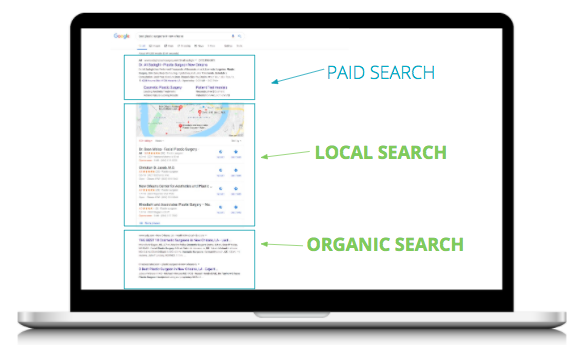
    A screenshot of Google's search results showing the difference between paid search, local search and organic search results

    This blog is all about making an impact in local and organic results, not paid search. Organic search refers to unpaid search results that appear because they are relevant. Local search refers to organic results for businesses or places that are in the same area as the searcher. These are often displayed as map results.

    Google decides which websites to show as local and organic results by considering three factors:

    • Relevance
    • Authority
    • Distance from the searcher

    Relevance is how well a business profile matches a consumer’s search results. Authority is determined by a business’s presence online (links, articles, or directories) and offline (landmarks or locally known brick and mortar businesses). Distance from the searcher is, well, relatively straightforward.

    Medical marketers must ensure that their practice’s online presence meets these three important Healthcare SEO ranking factors, which is where search engine optimization, or “SEO,” comes in.

    There are three key components to having a successful SEO strategy:

    • Keywords: What are people searching for? Which words or phrases do they use to find a new healthcare provider or information on a procedure?
    • Content: Does the content on a website truly answer the question the searcher was asking?
    • Connections: Does this website have backlinks or mentions from other, authoritative websites? Is there accurate information on the faculty, practice, or doctor listed on relevant directories like Google My Business or Healthgrades?

    Despite periodic updates to Google’s algorithms and how they rank search results, these three components continue to be the basis of earning Google’s trust and keeping your website relevant. However, the way medical marketers think about keywords or write content has to adapt over time.

    How Do Google Updates Impact Hospitals and Healthcare Practices?

    A stethoscope sitting on top of a keyboard representing online healthcare

    Google is extra critical of health-related websites and has defined a specific content category for pages with content that could impact a person’s happiness, health, financial stability, or safety. These are called YMYL (Your Money, Your Life) pages and include hospitals and medical practices. The “Medic” update in August 2018 reflected the level of scrutiny Google uses when reviewing websites that deal with health or healthcare. Their goal is to discourage misleading information and ensure that searchers find trustworthy advice.

    The credibility of the organization that runs the website impacts its rating, which is good news for large hospitals and other well known institutions. Hospitals are often considered a trusted source of information in their communities. On the other hand, smaller practices may have to work a little harder to prove their authority. But to rank well, it isn’t enough to be a trustworthy organization. The website must also have high-quality content.

    How to Create Good Content

    When writing content for a medical website, it’s vital to think about what Google considers good content and what information potential patients include in their searches. All content should be up to date, accurate, and user friendly. Marketers need to consider the following:

    • Be Specific and Substantive: Websites should have detailed, in-depth information. Try to avoid lightly touching on a subject without providing any useful information. Searchers look for clear answers to their questions.
    • Directly Answer Common Questions: Survey the medical staff to see the most common questions patients ask before, during, and after an appointment. Then, provide direct answers to these questions on the site.
    • Use Subheadings: Use subheadings as a way to guide the reader down the page and direct a searcher to the section of the content that has the information they’re looking for.
    • Use Bullet Points & Numbers: Break the information out into lists that are easier for readers to digest.
    • Look at Top Ranking Pages: When in doubt, see what the top results for targeted keywords are doing and borrow some of their ideas. What type of information do they provide? How are their pages organized?

    When considering what to write about, think of the keywords people are searching for and what information they expect to find. In the medical industry, there are typically two categories for searches: general health and healthcare. When someone searches a health term, they are looking for information about an ailment such as symptoms, causes, and treatments. Sites that rank for general health searches usually belong to large institutions, like the Mayo Clinic, which would be difficult to outrank.

    It is important to have local content to leverage Google Maps and Google My Business. When someone searches for a doctor or specialty, like an orthopedic surgeon, they’re looking for healthcare and are considering going to a doctor. Healthcare searches are typically local because people tend to look for treatment in their area.

    How to Rank in Local Search and on Google Maps

    The earlier discussion about relevance, authority, and distance ties back in here. For Google Maps results, distance is the biggest factor. The physical location of the searcher determines the range of results they see. There’s no easy way to move closer to a searcher, so marketers have to focus on the factors they can control:

    • Relevance:
      • Have quality content for each specialty or procedure the practice offers
      • Establish backlinks from trusted directories and other high ranking websites and local organizations
    • Authority:
      • Links pointing back to the practice’s site also improve authority
      • Earn media mentions and directory listings
      • Obtain and share as many quality reviews as possible with Google

    Remember that the MOST important directory to update is Google, and information in Google My Business should always be up to date! With a verified hospital or medical practice category listing, marketers can set up specific hospital information (such as the different departments or doctors) to give patients a more direct search result.

    If you’re ready to start improving your healthcare practice’s ranking for vital keywords in Google, Search Influence knows how to help. We help businesses grow online by developing SEO and digital marketing gameplans tailored for each of our clients. Request your marketing proposal and let’s make it happen today.

    Images:

    Stethoscope

  • Find the Best KPIs for Your Campaign in the Alphabet Soup of Google Ads Metrics

    Google Ads offers marketers an abundance of data, with countless metrics to track for every campaign. Some might consider this to be a gold mine of information, but it can be pretty overwhelming.

    Steve Urkel looking around confused gif

    How do you decide which metrics are the most important to track in your Google Ads campaign?

    Determine the Goals of Your Campaign

    There is no one-size-fits-all formula for optimizing and tracking the success of digital advertising campaigns. The most important step in determining the right metrics is to define what you want to achieve with a particular campaign. Depending on what you consider to be a successful campaign, some of the data will be relevant while other KPIs won’t be very helpful.

    No two ad campaigns are identical, but many fall under one of these broadly defined goals:

    • Driving traffic to your website
    • Increasing sales and conversions
    • Building brand awareness
    • Increasing your return on investment

    Goal 1: Drive Traffic to Your Website

    If the end result you are looking for is more website visitors, then the best course of action is focusing on metrics that involve clicks and keyword performance.

    Click-Through Rate (CTR)

    While you may be thinking clicks are king when indicating website traffic, your click-through rate is a better indicator of the performance of the campaign. CTR shows you the ratio of people who have clicked on your ad to the total number of people who have seen your ad (impressions). As DashThis’s Mark Christensen writes, this is an important KPI to track since it can show if your ads appeal to your targeted audience.

    A higher CTR can indicate better campaign performance and more site traffic. However, you want to keep in mind that if your ad copy weeds out unqualified clicks you might see a lower CTR. But don’t panic! Although the CTR may drop slightly, higher quality clicks result in more time spent on a landing page or website and can lead to another action taken by that user.

    Quality Score (QS)

    Improving your Quality Score is a great way to manage not only your keywords but also overall campaign performance. This KPI is a rating that ranges between 1-10; it measures the quality and relevance of your keywords and ads. Quality Score is one of various vital metrics and can affect where your ad ranks, as well as when or if it shows at all. Higher quality scores point to keywords and ads that are more compelling to your audience, increasing the number of clicks.

    Cost Per Click (CPC) is also determined by QS; higher QS leads to lower CPC. The goal should always be a low CPC since this allows for more clicks within your budget.

    Vince Vaughn The Internship gif

    Goal 2: Increase Sales and Conversions

    In a Google Ads campaign, a conversion could be one of several actions like a purchase, newsletter signup, app download, or a phone call. To measure the success of a campaign with a conversion goal, it’s crucial to first correctly set up conversion and lead tracking.

    Now you’ll be able to properly track the Cost Per Conversion and Conversion Rate.

    Cost Per Conversion/Acquisition (CPC/CPA)

    Cost per conversion measures the amount you spend per completed conversion or another desired action taken by a user. It’s the total cost of generating traffic (ad spend) divided by the total number of conversions. This is the best metric for understanding the financial effectiveness of your campaign, especially when the conversion goal does not lead to direct or immediate revenue.

    Conversion Rate

    This ratio compares the number of clicks and conversions. It’s the rate at which users take the desired campaign action after they click the ad. Conversion rate can provide major insightsx for optimizing your campaign. It should tell you which keywords, ad copy, and landing pages are performing best for your campaign goal.

    For a new campaign, don’t immediately jump the gun on a low conversion rate; give your ads time to acquire impressions and adjust keywords or bids as needed.

    Both conversion rate & CPA can be good indications of how to reallocate your budget to get the most bang for your buck. If you put more of your budget toward campaigns with higher conversion rates and lower CPAs, you should see a better return on your investment.

    Goal 3: Build Brand Awareness

    Whether you are marketing a product, service, or even a cause, the goal of brand awareness is to increase visibility and reach a larger audience. Impressions should be the focus here.

    Impression Share

    Impression share is calculated by dividing the total number of impressions you got by the number of opportunities that your ad could have shown. Working to lower your CPC, CPA, and increase your QS can go a long way to benefit your campaign’s Impression share.

    While the impression share is helpful, what might be even more helpful to know is why an ad isn’t showing to your audience. Lost impression share metrics can help you find that answer.

    Lost Impression Share

    This KPI is the percentage of time that your ad does not show because of budget restrictions or ad ranking. As Adam Proehl of Search Engine Journal writes, “The closer the number is to the difference between 100 and the “search impression share”, the more likely you are to find additional conversions simply by boosting the budget.”

    Sometimes your resources may just be too limited to increase spend. Instead, optimize your campaigns to drive traffic to the most valuable conversions.

    Goal 4: Increase Return on Investment

    Return on Investment (ROI) is the ratio of benefits to costs. In Google Ads, Return on Ad Spend (ROAS) is the return you generate for every $1 spent on ads. For example, a total ad spend of $600 with revenue from ads of $4200 would equal a ROAS of 7.

    ROI/ROAS is considered one of the most important metrics for advertisers because it’s based on your specific advertising goals and shows the financial impact of your advertising efforts. These ROI metrics are the ones you’ll want to highlight for the boss (or client) when the campaign performs well.

    Dwight Schrute 'We did an awesome job' meme

    If navigating Google Ads to scrounge up relevant KPIs makes your head spin, there’s no need to hit a wall. Search Influence can help you understand and track the metrics that matter so you can reach your digital advertising goals.

    Images:

    Steve Urkel

    Dwight Schrute

  • CCPA and Political Ads: What You Need To Know and Why It Can’t Wait ‘til 2020

    The recently-passed California Consumer Privacy Act and proposed changes to political ads will change the digital marketing landscape in 2020. I know what you are thinking: 2019 just started, why should I already be concerned about complying with new rules and regulations that go into effect in 2020? As many companies learned through complying with the GDPR (General Data Protection Regulation), it’s much better to start implementing changes as soon as possible.

    With the recent breaches of consumer data, privacy and transparency have been major concerns. Passing the GDPR in 2018 was a huge step toward combating privacy concerns, but U.S. companies can still expect much more to come in the way of regulation and legislation. Not only will the US start enforcing their own data regulations, including the CCPA, but new rules are arising that would require greater transparency for political advertising.

    Lock on the keyboard of a computer at Search Influence in New Orleans, LA

    Key Components of the California Consumer Privacy Act (CCPA)

    Effective January 1, 2020, the CCPA aims to protect the privacy, security, and rights of California consumers. The law allows citizens, or the state itself, to bring action against a company for violations of the law. According to Varions, the rights given to Californians from this privacy act include the following:

    • Know what personal information is being collected
    • Know if their personal information is being sold or disclosed and to whom
    • Say no to the sale of their personal information
    • Access to the personal information that is being collected
    • Equal service and price if they choose to exercise privacy rights

    Why Being GDPR Compliant Doesn’t Mean You’re Automatically CCPA Compliant

    While the goals of the CCPA and the GDPR are extremely similar, businesses need to be aware that just because they comply with the GDPR requirements does not mean they are compliant with the CCPA. In many ways, the CCPA expands on ideas and regulations of the GDPR. For example, the CCPA requires a way for consumers to control their own information, as opposed to the required consent for data in the GDPR. The CCPA’s rule on notifying consumers if their data is sold to third parties and allowing them to opt out is another major difference.

    So what do marketers need to do to prepare for this 2020 deadline? First and foremost, they need to be sure to closely examine the data that they currently collect and how it is used. Data fields on forms, profiles, and landing pages are an important part of this scrutinization process. If they collect personal information, clear language and cookies need to be in place to inform users about what information will be stored, shared, or sold. Privacy policies must also be updated with steps the consumer can take to have their personal data deleted.

    What Could Change With Political Advertising for the 2020 Elections?

    The 2020 elections are not far off, and many political campaigns at both the national and statewide level have already been kicked off. After the controversy over the 2016 elections, protection of data and transparency with political advertising has been top of mind. In March of 2018, new regulations were proposed by the FEC for how political advertisers should run disclosures that are clear about who paid for the ad. After commissioners met in June, there was still no clear decision for an approved proposal.

    Currently, the FEC law requires that advertisements include disclaimers for three ad types: Communications by Political Committees, Express Advocacy by Any Person, and Solicitations by Any Person. The newly proposed rules would apply to the same ad types, but require that these ads state who paid for them and if a candidate authorized the ads. Another difference these policies propose is that advertisers will no longer be able to omit ad disclaimers based on size constraints. Instead of omittance, “adapted disclaimers” must be used, which would have the largest impact on online advertisements.   

    Keep in mind that while the majority of marketers may not be working directly with a political campaign, these rules still apply to anyone who expressly advocates for or against a candidate in paid digital ads. This could encompass a large variety of digital advertising users, even outside the realm of politicians. The urgency behind the push for new policies should encourage all advertisers to be more transparent in regards to paid political ads, not only in preparation for inevitable future regulation but also in an effort to maintain good faith with consumers.

    Despite the fact that the FEC has yet to pass an official regulation from these proposals, the Digital Advertising Alliance (DAA) has implemented new guidelines “designed to bring greater transparency and accountability” to political advertising. Under these guidelines, the DAA is urging political advertisers to use a purple PoliticalAds icon in the top right corner of ads, which will link to any required disclosure information. For advertisers using this icon, there should be little to no work left to do in order to comply with the FEC regulations once a final decision is made about the proposed disclaimer policies.

    Woman tapping on her watch at Search Influence digital marketing agency in New Orleans, LA

    What Else to Expect Before 2020

    A lot is still changing as far as privacy regulations are concerned. The CCPA has seen a lot of criticism for how quickly the law was pushed through, and for what some say is oversight on how certain aspects will be enforced. This backlash has led to speculation that the CCPA could still see a lot of change before it goes into full effect on January 1, 2020.

    Advertisers should be sure to keep an eye out for any more changes. Many data collectors are now pushing for federal regulation before other states pass laws and create a patchwork of varied laws, making compliance across the country much more difficult. However, don’t be deterred from continuing to take advantage of digital advertising channels. As stated in our recent blog by Alison Zeringue, spending on digital marketing and advertising has continued to grow. In addition to spending more on digital advertising, we are also seeing marketers increasing the use of targeted audiences, despite new regulations and privacy concerns being at an all-time high.

    If you’re concerned about the changes to digital advertising, the experts at Search Influence are here to help. We follow the news and the trends to ensure that our clients’ digital marketing campaigns are effective while following the letter of the law. In addition to creating regulation-compliant online ads, we track their performance as well. Start a conversation today to learn more about how we can help your business grow.

    Image:

    Tapping on Watch