Author: Brandt Arceneaux

  • How to Target Adult Learners and Non-Traditional Students With Digital Advertising

    Key Insights

    • Use information about current students to find new ones
    • Your platform and messaging will depend on your student personas
    • Prioritize degrees or programs that contribute to overall success
    • Follow the data and don’t be afraid to change your targeting plan

    College graduation ceremony with graduates in caps and gowns

    No one would dispute the value of a college degree in the current job market. Not all schools are created equal, though. Each institution has its own values, strengths, and community. That’s why it’s important for college marketers to display the best values of their organizations.

    Marketers can support this goal by delivering high-quality leads by targeting the right audience. This is especially important when universities target non-traditional students, also known as “adult learners.” This blog post details some great ways to target non-traditional students and create effective campaigns to reach them.

    Analyze the Profiles of Enrolled Students to Define a Target Audience

    So, how can marketers figure out which audience to target? Start by painting a picture of the student body. Student profiles, or personas, give marketers a proxy target for prospective students. Colleges often have terabytes of data from inquiries, applications, and enrolled student profiles. This data can be invaluable for determining your personas.

    Different programs and schools within the university will have their own student persona (or several personas). The student body in the engineering program will probably look different from the MBA program’s student body. Most importantly, non-traditional students won’t look like newly graduated high school seniors, so it’s critical to know the differences between each student population.

    For each program, marketers will also need a good sense of what prospective students look like at each stage of the admissions process. Ideally, marketers should know when people make inquiries, apply, accept admission, and pay tuition to start classes.

    What if you don’t have robust data? In these cases, it’s important to work with other departments to build the best profiles possible and develop a strategy.

    Find Prospective Students on the Internet

    After using data to create a profile of the target audience, the next issue is where to advertise. Marketers can reach prospective students on a variety of websites and apps based on their affinities.

    The answer depends on the relevant student persona:


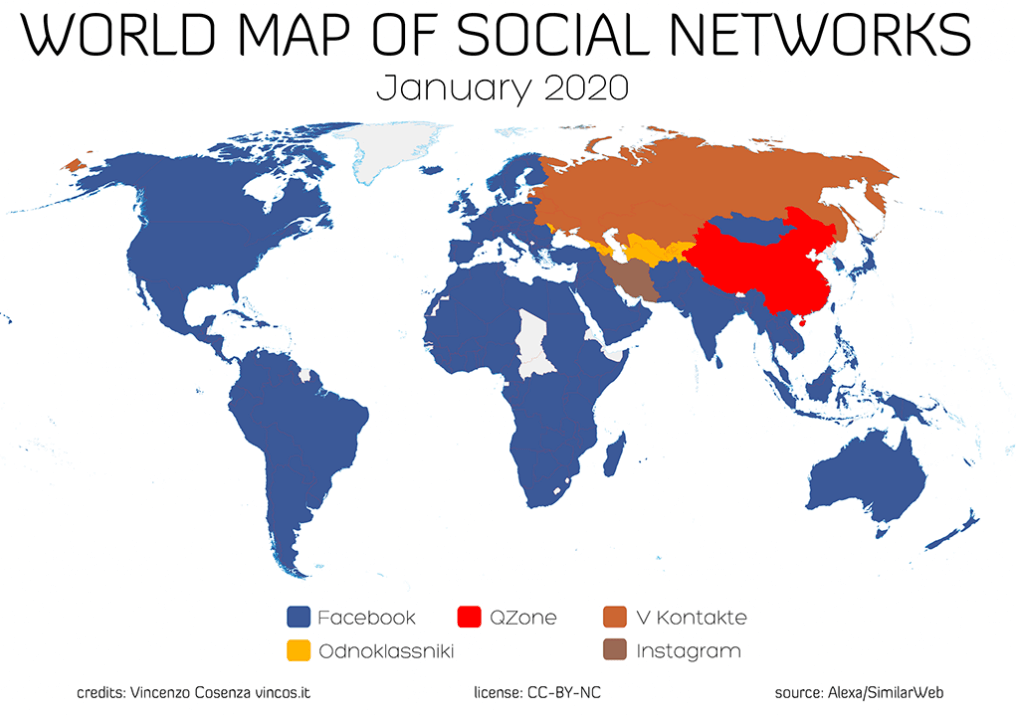
    Map of worldwide social media channel usage

    Luckily for marketers who want a simplified campaign, all of these groups have Facebook in common (considering that Instagram and Facebook are integrated). It’s not surprising that so many education marketers use Facebook. The platform has great targeting options and 2.7 billion monthly users. Facebook is great for college marketers in general because of the ability to target prospective students based on their locations, ages, and interests. There are other options that are more specific, such as occupation, education, family situation, life events, and more.

    Of course, there are always Google Ads campaigns. Placing ads on Google will help with targeting non-traditional learners who are looking for degree programs or the education requirements for making a career change. However, for increased targeting, Google Display is the way to go.

    Campaign Structure Tips

    With a well-defined audience and various platforms for targeting, the next step is translating this information into a structured campaign. Segmenting ad campaigns based on each degree is a logical first step because messaging can be so different for each program.

    For example, a culinary arts program may have two primary personas:

    • Entrepreneurs who want to open a restaurant
    • Current restaurant employees who want to move up in the industry

    Marketers can build one campaign for the entire culinary program and create different messaging and targeting to reach both of these personas.

    An effective campaign will also have separate messaging for prospective students who are in different stages of the sales funnel. For example, marketers probably won’t have much luck with a call-to-action like “APPLY NOW!” with people who have only just found out about their culinary program. On the other hand, something lower-touch like “Request more information” or “Sign up for a free admissions webinar” can help nudge prospects from Awareness to Consideration and Conversion.
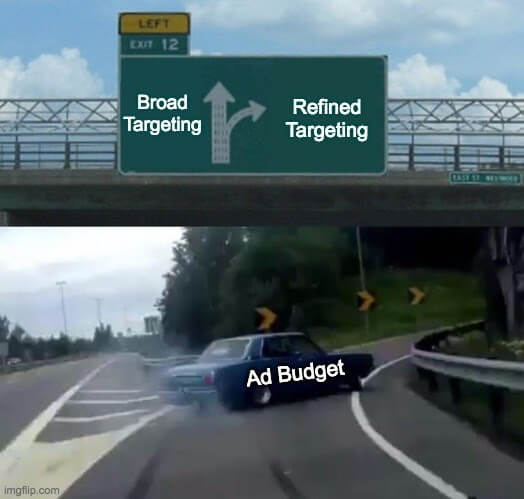
    Car veering into an exit showing broad vs refined targeting for ad budget

    When setting up targeting, marketers need to compile a list of characteristics for each persona and set up their campaigns to reach those people. Becoming more familiar with each platform’s targeting options will help reach more prospects. For Google Search ads, the most basic targeting is choosing geographic areas. For other campaign types, this usually means additional targeting options. For example, marketers could target people in the market for master’s degrees on Google Display or current community college students on Facebook.

    The last step is creating a budget. Each department will have an opinion about where the most budget should go. It may be tricky to come to an agreement everyone likes. The important thing, though, is to focus the budget where it’s most likely to help reach the school’s goals.

    Once a campaign is running smoothly, it’s time to sit back, relax, and… constantly optimize your campaigns. If you’d like to talk to a strategist about a campaign you’re planning or are already running, Search Influence has a team of experts ready to help you meet your goals. Contact a member of our team today.

    Images

    Graduation

    World Map

    Left Exit Meme

  • Facebook’s Pared-Down Targeting is the New Deal… But Is It a Big Deal?

    If you are as enthusiastic about Facebook advertising as the nerds at Search Influence, then 2019 was an exciting year for you. Among other developments, Facebook made some major changes to their targeting options, beginning in the Spring with new requirements for Special Ad Categories like housing, financial services, and employment. These new targeting restrictions were intended to prevent advertisers from doing what I call “creative discrimination,” for example, only targeting high-income people for real estate ads. Many resources explain these new Special Ad Categories and how to create effective audiences for them.

    Spiral staircase photographed from the top down

    However, in Summer 2019, Facebook announced another round of changes to targeting, including thousands of interest, behavior, and demographic criteria. This time, there was very little information available about the upcoming changes, and advertisers were understandably agitated. Facebook announced, “As of August 19, 2019, some targeting options may no longer be available for new campaigns.” Digital advertising discussion threads from Reddit to Quora lit up with discussions and speculation about the new changes. Advertisers feared they either wouldn’t be able to target their ideal customers anymore or that it would become more expensive to target them.

    I have great news, though: you probably have nothing to worry about. Three major factors should help mitigate your fears. First, although Facebook was not specific about which targeting features they removed, advertisers found that the criteria removed were outdated, redundant, or just not that useful. Second, creative advertisers could leverage other targeting criteria to make up gaps in audience coverage. Finally, cleaning up available targeting criteria falls in line with Facebook’s push for broader targeting in advertising campaigns.

    Facebook Taketh Away… But Also Giveth

    Before the changes took hold, Facebook helpfully highlighted affected audiences in Ads Manager so advertisers could get a head start on editing their targeting. The eliminated categories were largely irrelevant to all but the most targeted campaigns. For example, here at Search Influence, we found that some removed targeting options included song titles, foods, and streets in the French Quarter.

    Facebook suggested appropriate replacements for some of these targeting options (“Louisiana Creole Cuisine” instead of “shrimp and grits,” “French Quarter” instead of “Royal Street,” etc.). Some other criteria did not have a suggested replacement, but we found them easy to discard or replace with better targeting. Other removed categories included particular job titles, interests, and behaviors whose audience sizes were very small and not very useful. The result is that although thousands of categories were removed, there are still many ways to reach the exact audience you want with your Facebook ads.

    Introducing… The Replacements!

    Even advertisers who relied heavily on precise targeting could still find their ideal audiences with clever workarounds. As I noted above, Facebook offered alternatives for removed criteria right in Ads Manager. These alternatives seemed widely relevant and showed that Facebook had put some thought into the effects of their changes. Savvy advertisers immediately researched alternative criteria to replace the ones that had been removed.

    For example, we could replace the interest “Royal Street” (a shopping mecca in New Orleans’ French Quarter) with the interests “shopping” and “French Quarter.” This alternative could not only replace the “Royal Street” interest but could also help us reach other audience members who are likely to convert on our ads.

    Broaden Your Advertising Horizons

    Speaking of reaching more audience members, advertisers realized these changes fell in line with Facebook’s advice of broader targeting from advertisers. This advice seemed counterintuitive to many advertisers, who saw targeting changes as a ploy to force Facebook advertisers into paying more. However, Search Influence has found that broadened targeting has improved performance in many of our campaigns.

    Facebook explains broad targeting as “mostly relying on our delivery system to find the best people to show your ads to.” Essentially, you are leveraging a tool that Facebook has spent millions of dollars optimizing. As Facebook points out, “This approach can lead to us finding potential customers you never would’ve known about otherwise.”

    To help advertisers transition to this unfamiliar method of casting a wider net, Facebook bolstered some Ads Manager tools to help advertisers evaluate audience performance. The Audience Insights feature now shows advertisers detailed information about their audiences, allowing for better optimizations and planning.

    Along with new analytic tools, Facebook rolled out and encouraged advertisers to use the Detailed Targeting Expansion setting with somewhat broad audiences. This feature allows Facebook to find users who are similar to your audience for detailed targeting but can provide better results for your campaign at a lower price. Many advertisers have had success with broad targeting and Detailed Targeting Expansion and now advocate for simplified campaigns as a way to let Facebook do the work for your campaign.

    Target with arrows piercing the yellow center

    Stay on Target

    If you’ve made it this far since the targeting changes without any problems, you should be good to go. Because there are still thousands of options left to help you find those high-intent audience members, you may not even have noticed that thousands of options are suddenly gone. There are lots of ways to find your audience members, even if it means some creative combinations of interest, behavior, and demographic targeting.

    Finally, embrace broad targeting. Facebook has invested millions in technology that predicts user behavior, so do yourself a favor and use it. At the very least, testing your ideas against Facebook’s algorithm is a prudent way to optimize your campaigns. If you need help setting up a Facebook campaign or running tests in your current one, contact Search Influence to collaborate with one of our digital advertising experts!

    Images

    Stairs

    Target

  • Nine Reasons Facebook & Instagram Ads Are a Powerful Combo

    If you asked someone to name a social media network five years ago, their answer would probably have been “Facebook.” But in 2019, there’s an entire social media ecosystem with distinct content, styles, and user groups. Facebook continues to dominate, but with such a dynamic social media landscape, who knows how long that will last. For marketers, the uncertainty can be unnerving.

    The good news is that digital marketing spend is growing steadily. The great news is that just two of the major social media networks will give you incredible advertising coverage. As a bonus, you can create ads and manage campaigns on both networks with one ad platform. Of course, I’m talking about Facebook and Instagram. Let’s look at some statistics to see how powerful this combination can be.

    Map of the world

    Facebook: Older and More Experienced

    Facebook has been the world’s leading social media network since January 2009. The company announced that it had reached 500 million users in July 2010. As of March 2019, Facebook had 1.56 billion active users each day and 2.38 billion active users each month. Facebook has more daily users than the entire population of India.

    According to Statista, 214 million American adults used Facebook by the end of 2018. The most well-represented age range was 25 to 34, with 58.3 million users. Even though the bulk of its users are over 35, Facebook has 46 million American users under 25.

    By early 2019, about 69% of adults in the U.S. used Facebook. YouTube is the only major social media platform in the same range, with 73%. Facebook remains popular with all demographics but attracts certain groups at higher levels. About 75% of U.S. women use Facebook, compared to 63% of men. Users also differ by education level. Around 74% of adults with a college degree use Facebook, compared to 61% of those with a high school diploma or less.

    Facebook, like MySpace before it, was once considered a platform for younger users. About 79% of people aged 18 to 29 use Facebook, while only 46% of users are 65 and older. But users over 65 have more than doubled since 2012. This reflects Facebook’s diversification from mostly features for socializing to ones that include marketing, shopping, event management, news, and other aspects of business.

    Though Facebook has reached new global user records, its U.S. market share has been declining for a few years. Facebook once enjoyed 70% of the American market, but this has slipped to 36.6%. Data from 2019 revealed that about 15 million fewer Americans use Facebook compared to 2017. The losses have mainly been in the teen and millennial groups. Other networks like Instagram, Snapchat, Pinterest, Reddit, and WhatsApp have picked up the slack.

    Walking during a Pride Parade

    Instagram: Younger and Faster

    Instagram has become insanely popular since its 2010 launch. The photo-sharing app has bloomed into a news source, marketing tool, social influence platform, and meme-sharing community. About 500 million people use Instagram every day, and over 1 billion use it every month.

    Instagram’s largest market is the United States, with over 120 million active users. In February of 2019, about 67% of U.S. adults from 18 to 29 used the platform. Around 72% of U.S. teens and 35% of U.S. adults use Instagram.

    Unlike Facebook, Instagram has not become as popular with older age groups (yet). Facebook attracts about 79% of U.S. adults from 30 to 49, while Instagram attracts only 47% of the same group. People over 65 rarely use Instagram and only make up about 8% of its users.

    Although Instagram has a smaller user base than Facebook, Instagram users tend to use the app heavily. Over 76% of Instagram users 18 to 29 use the app daily, while 60% use it multiple times per day. Instagram users are also prone to use multiple social media networks: 95% of Instagram users also use YouTube, 91% use Facebook, and 60% use Snapchat.

    When Your Powers Combine…

    So, to recap: Facebook has been losing market share and its user base is getting older. Teens and millennials are moving towards Instagram and other networks. These factors make a compelling case for shifting your advertising focus to Instagram.

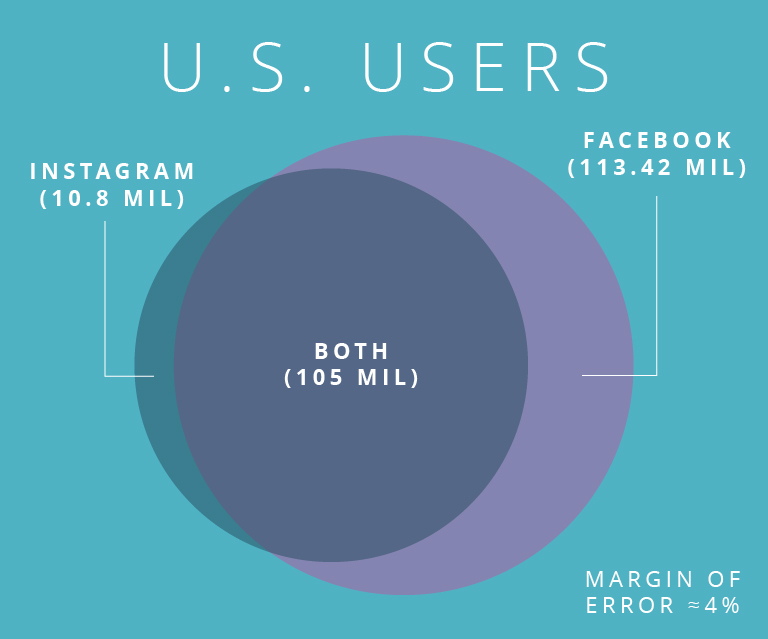
    Luckily, you don’t have to make that decision. Since Facebook has integrated advertising through Ads Manager, you can reach Instagram and Facebook users on one platform. Even better, about 91% of Instagram users use Facebook, so you can potentially reach 323 million Americans with only Facebook ads.

    However, with just a few tweaks of our ads, we can optimize them for both Facebook and Instagram. This is a level of direct access for marketers that hasn’t been available since the expensive days of mass mailing. Now, with a few clicks, you can deliver your message to millions of potential customers.

    Here are nine reasons marketers should be advertising on both Facebook and Instagram in 2019:

    • The combined U.S. audience of Facebook and Instagram is about 230 million users, who are all reachable with one ad platform.
    • 2 million brands are using Instagram Stories to tell their brand’s story.
    • 60% of Instagram users discover new products on the platform.
    • 78% of Facebook users discover new products on the platform.
    • 50% of Instagram users follow brands, the most of any social media network.
    • Instagram users are 70% more likely to buy on their mobile devices.
    • The average Facebook user clicks on 8 ads per month.
    • Facebook’s e-commerce click-through rates tripled between 2017 to 2019.
    • TV advertising costs 10x more than Facebook videos, for the same size audience.

    As you can see, there is huge potential for marketing on Facebook and Instagram, despite Facebook’s supposed “saturation” and Instagram’s less serious reputation. Facebook and Instagram have millions of users in the U.S. This audience includes 72% of teens, about 80% of millennials, and 46% of the elusive 65+ crowd.

    Facebook and Instagram’s large market shares, combined with the targeting features in Ads Manager, means marketers can find and reach potential customers more easily than on other platforms. The browsing behaviors of users on both platforms means that marketers have a higher likelihood of making a sale. All of this means a higher return on investment and happier marketing directors. If you’d like more information on leveraging social media to generate more business for your agency, contact our team at Search Influence for a digital marketing analysis.

    Images
    B & R
    Map
    Parade

  • Sad That Google’s Retiring Average Position? Here’s How You’ll Be Better Off

    As Google has grown into an advertising powerhouse, it has created and improved ad performance metrics. After all, why would advertisers stick around without actionable data for boosting performance?

    Average Position is one metric that has been around since the launch of AdWords in 2000. You, like many other advertisers, may use this metric to track the success of your online ads.

    In late 2018, Google announced they would retire Average Position in September 2019. Let’s take a look at what this means for advertisers.

    What Does Average Position Mean?

    The Average Position metric shows the average position where ads are appearing on the search engine results page (SERP). At least, that was its original function.

    At first, Average Position helped advertisers gauge the effectiveness of their account changes. It’s easy to see why: if you know where your ads are appearing, you can work your way up to the top of the SERP with adjustments.

    Everyone wanted to be at the top because research showed that top search results get the most clicks by far. The Average Position metric was crucial for advertisers chasing the most valuable SERP space.

    What’s more, the immediate visibility of an ad at the top of the SERP made Average Position a popular, tangible metric.

    Great! We have an intuitive, valuable metric to measure our advertising performance. Why on Google Earth would they get rid of it?

    Princess Bridge gif for Search Influence blog post about Google Ads

    The Decline and Fall of the Average Position Metric

    … Because it’s no longer intuitive, and that makes it much less valuable. Let’s look at what changed over the years.

    Average Position used to be helpful when all ads appeared above the organic results. If your ad’s average position was 1, it meant the ad was at the very top of the SERP.

    Later, ads appeared at the top of the SERP and also down the right side. Google realized they could combine the ads’ spaces and create an auction for all the real estate on the page.

    Google restructured the SERP so only highly relevant ads would appear above the organic results. If no ad was relevant enough, they all appeared on the side of the SERP or below the organic results.

    Advertisers could no longer be certain where their ads were appearing. Even auction winners may never appear at the top of the page. By this point, Average Position was more of an “Average Auction Rank” metric.

    By now, Average Position data was less helpful for optimizing campaigns. There was just no good way to know where on the SERP your ads would appear. Even your best ads could be languishing at the bottom of the page in the dreaded No Click Zone.

    Average Position lost more value as Google reorganized the SERP and added features. So, what’s an advertiser to do? How can we find out how our ads are appearing to our audience? What will save our KPIs?

    New Metrics to Save the Day

    Google introduced two new position metrics ahead of the retirement of the Average Position. These new metrics are helping advertisers transition more easily. Here’s what they tell us:

    • Search Top Impression Rate is the ratio of impressions appearing anywhere above the organic results. It’s given by Impressions Above Organic / Total Impressions.
    • Search Absolute Top Impression Rate is the ratio of impressions appearing above all of the other ads that are above the organic results. It’s given by Absolute Top Impressions / Total Impressions.

    Raccoon gif for Search Influence blog about average position in Google Ads

    There are also a few helpful Impression Share (IS) metrics you can bid for to increase Impression Rates:

    • Impression Share (Top and Absolute Top) is the ratio of impressions at the top or absolute top of the SERP and the impressions you were eligible for.
    • Search Lost Impression Share Budget (Top and Absolute Top) shows how often your ad wasn’t top or absolute top because of budget limits. This metric can help with bidding and budget changes for more top-of-SERP impressions.
    • Search Lost Impression Share Rank (Top and Absolute Top) shows how often your ad wasn’t top or absolute top because of your ad rank. This metric can help identify ad copy and landing page changes for more top-of-SERP impressions.

    With these new metrics, advertisers are better able to gauge when and how often their ads appear at the top of the SERP. Moreover, with the Lost IS metrics, advertisers can dial in their optimization efforts to where they will have the most tangible impact on ad placement.

    Even though Google is retiring a much-loved metric, it’s safe to say that advertisers will wind up with even more and better information than before. Overall, this move is a boon to advertisers who crave control and incremental performance improvements.

    What This Means for Advertisers

    There’s no reason to be upset over Average Position. The first step is to familiarize yourself with the new metrics. Once you begin using them, you’ll quickly see how useful they are. Here are three ways the new metrics will benefit advertisers:

    First, advertisers will be able to create more competitive campaigns with these new metrics. For example, at Search Influence, the new metrics are working well along with the new Auction Insights tool. Using both gives us a starting point for optimization tasks. Now we have to do much less detective work to identify performance-increasing adjustments.

    Second, we can examine how our other KPIs (like CTR) are affected by our ad’s position on the SERP. This means we can zero in on the external and internal factors affecting our ad placements and we have more optimization options available.

    Finally, the new metrics will help engaged advertisers stay on top of their ad performance. Even not-so-engaged advertisers should find campaign optimization easier. Both groups should capture more valuable impressions and clicks with less testing, guesswork, and time.

    If you’d like to know more about how to boost your advertising power, get in touch with the digital advertising experts at Search Influence. We’ve got the expertise and experience to help you reach your business goals.

    Welcome! Everything is fine with Google Ads

    Images

    Princess Bride

    Raccoons

    Everything is fine.