Author: Anita Nagle

  • Top 7 SEO Questions You May Be Asking

    This post was updated by Shira Pinsker on 8/31/2022 to reflect recent trends and refreshed statistics. It was originally published on 7/19/2021.

    Key Insights

    • A search engine optimization campaign aims to increase both the quality and quantity of organic traffic to your site.
    • The primary function of search engines is to deliver answers to questions in the most digestible way possible. This is the most important thing to remember when executing an SEO strategy.
    • SEO is a long-term strategy that, when done correctly, pays dividends in results.

    A strong search engine optimization (SEO) campaign is an essential tool for any digital marketing strategy. While effective paid advertising, social media, and other digital strategies are important, organic search brings in the majority of website traffic.

    Effective SEO campaigns can help drive conversions, improve user experience, and ultimately lead to increased customer satisfaction. In this post, we’ll provide the answers to seven SEO questions clients commonly ask.

    Person at desk viewing Google landing page on laptop

    1 – What is SEO?

    Search engine optimization is the “practice of increasing both the quality and quantity of website traffic and exposure to your brand through non-paid search engine results.” (Moz) SEO is performed through a combination of updates both on and off your website to help Google better understand who you are, what you do, and why searchers should see you at the top of search results.

    The most popular SEO tactics include content creation, technical improvements, and link building.

    2 – How do search engines work?

    The goal of Google, Bing, and other search engines is to display the results that are most likely to answer a user’s query in the most digestible format.

    Search engines take three steps to find, analyze, and rank content:

    • Crawl: Search engines comb the Internet and read over the code and content for each URL they find.
    • Index: Search engines store and organize the content found during the crawling process.
    • Rank: Search engines deliver content on the search engine results page (SERP) that is most relevant to a user’s query.

    3 – How does Google rank results?

    To determine organic ranking, search engines use algorithms, a process or formula by which stored information is retrieved and ordered in meaningful ways. The algorithm is ever-changing; in fact, modifications are made on a daily basis. Search engines use three factors to rank pages: relevance, location, and authority.

    • Relevance is how your business matches what the searcher is looking for. The primary ways we send signals for which queries are relevant to your business are:
      • Content: All the text, videos, and images on your site. A huge factor in where your page will rank is how well the content on that page matches a search query.
      • RankBrain: The machine-learning portion of Google’s algorithm. While Google does not reveal the specifics of RankBrain, we do know Google’s main goal—fulfilling searcher intent. The best way to fulfill search intent is to provide the most accurate information in the best way possible for people who visit your page. Beyond content, the other factor here is user experience. How easy is it for users to find the information they are looking for on your site.
    • Location plays a big role in local search results as they are very attuned to the searcher’s location or the location included in the query. We can reinforce location information through:
      • Content: Using location in metadata and the body of content.
      • Schema markup: Code that tells search engines what content means. Location schema markup helps search engines easily identify and decipher location information.
      • Listing management and building: Building and maintaining correct business listings not only ensures users have the correct location information but also ensures Google has this information and reinforces your location.
    • Authority—being well known and trusted—is another important ranking factor. We send authoritative signals to Google by:
      • Backlinks: Links from other websites that point to your website. These work similarly to word-of-mouth referrals in real life. Both quantity and quality of these “referrals” are important. We want links from other sites that Google trusts.
      • Reviews: The number of reviews a local business receives, and the sentiment of those reviews, have a notable impact on their ability to rank in local results.
      • Citations: Multiple, consistent references to a business’s name, location, and phone number strengthen Google’s “trust” in the validity of that data.
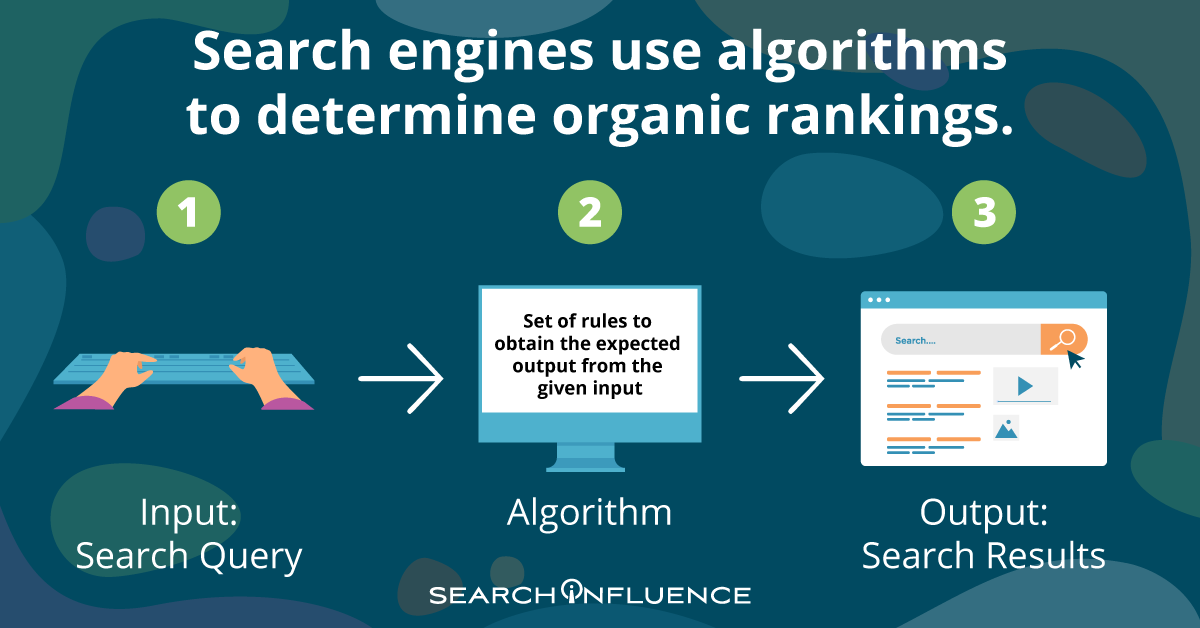
    Graphic explaining process of search engines algorithmic rankings

    4 – How much content does a page need?

    A common practice for determining word count is to match the length of the top-ranking pages for your targeted topic. While this method may help you figure out how thoroughly you should cover the topic, Search Engine Journal reminds us “it is important to remember that copy on a page should be there to aid the human visitor, not a search bot.” User intent is king in terms of determining the length of content. The key is to think about what a user is looking for when landing on your page from organic queries. Is your target audience looking for a quick, concise answer or a longer, more in-depth explanation?

    5- When will I see results?

    The timing of results from an SEO campaign can vary based on the strategies deployed, the competition within your industry, and your business’s characteristics. You can typically expect to see organic improvement at six, nine, and 12 months.

    After deploying a targeted strategy, such as optimizing the content on a specific page, you will likely see initial movement in results (organic traffic to that page or keyword rankings for that targeted topic) at six months. Then, you can expect to see further growth at the nine-month mark. Finally, you should see a larger jump in results at 12 months.

    6 – Why do my rankings fluctuate?

    Fluctuations in rankings are completely normal and very common. Search engines are constantly crawling and recrawling websites and indexing new information. This means that a page’s rankings will naturally rise and fall as you and your competitors adjust your websites. Also, algorithm updates can cause these fluctuations because they affect how the ranking process works.

    7 – How long do I need to run an SEO campaign?

    The short answer here is forever. Search engine optimization is a long-term strategy. The internet is constantly evolving, and so are search engine results. Google is constantly improving its ranking system based on providing the best user experience, and therefore, what may have been best practice three years ago, may not be today.

    Need help navigating the world of SEO? Search Influence is here to help. Contact our SEO experts to learn more about digital marketing strategies that can drive more customers to your website.

    Images

    Laptop


  • Top 6 Marketing Planning Activities During COVID-19

    During this time of crisis, many businesses may find themselves with extra time on their hands, but limited money to spend on marketing. While it can be hard to think about the future, this is the perfect opportunity to do just that and take a deep dive into your marketing plan. Luckily, we’re here to help.

    We’ve laid out the top 6 marketing planning activities to ensure your business is ready to hit the ground running, once you’re able to resume business as normal.

    Person using highlighter on business documents on desk

    1. Reconsider Your Marketing Efforts

    Collect all your marketing efforts into a master list and determine their relevance. Your list may include:

    • Website
    • Digital paid advertising (Facebook, Google, LinkedIn, etc.)
    • Google My Business listing
    • Review channels (Yelp, TripAdvisor, etc.)
    • Social media pages
    • Other listings or directories

    Do these tactics still make sense? For example, is your business listed in a directory that is no longer relevant to the services you provide?

    2. Optimize All Current Marketing Strategies

    Audit each tactic and ensure it is optimized. A basic checklist for various platforms:

    • Website
      • Is your site structure intuitive? Do you have a clear navigation?
      • Does each page contain a call-to-action?
      • When was the last time you wrote content?
      • Do you have metadata for each page?
      • Is your website mobile friendly?
    • Listings/Directories
      • Is all information up-to-date?
      • Ensure your name, address, phone number, and website URL are consistent across all listings/directories.
      • Add any additional information you can to flesh out your listing in order to increase organic rankings.
    • Review channels
      • Evaluate both the quality and quantity of reviews on all channels, paying special attention to Google, Facebook, and Yelp.
      • Are you utilizing reviews/testimonials on your website?
      • How are you soliciting reviews? Can this process be improved?
      • How often are you responding to reviews, both positive and negative?
    • Social media pages
      • Do all of your social media channels accurately reflect up-to-date business information and brand?
      • How often do you post on social media channels?
      • Is your tone, voice, and messaging consistent across platforms?
      • Are you utilizing all relevant platforms?
    • Digital paid advertising
      • Are you consistently monitoring all forms of digital paid advertising?
      • Look at the data. What trends are you seeing? Verify if you’re getting an adequate return or results. How has this changed over the years? Is there a better allocation for these dollars?
      • Do you need support? Speak to a digital paid advertising specialist.

    3. Perform Competitive Research

    Evaluate how your current strategies stack up to your competitors by performing competitive research and analysis.

    • Identify your competitors or similar businesses.
    • Perform a SWOT analysis on your business’ and your competitors’ websites, social media, content marketing, and digital paid advertising.
    • Pro tip: an easy way to see your competitors overall web presence is to simply Google keywords relevant to the business or industry.
    • Take a look at what your competitors are doing in areas they excel in. Can you implement any of these strategies into your marketing plan?

    4. Develop Marketing Materials

    Quality marketing materials are imperative to a successful marketing strategy but can be extremely time consuming to produce. Time is on our side right now, and the creation and curation of marketing materials can be done at little to no cost!

    Restaurant owner taking photographer of their menu items for marketing use

    An easy place to start developing marketing materials is taking photos. Pick up your smart phone and start snapping away. A few tips for success:

    • Use the photography composition rule of two-thirds, which suggests how you arrange subjects in your frame. Most digital cameras have an option to add the rule of two-thirds grid onto the screen.
    • Focus on one subject. When appropriate, stage people in your scenes – grab your roommate, significant other, or a family member. (Of course, follow appropriate social distancing guidelines!)
    • Lighting is key! Ensure you have great—ideally natural—lighting, and that your space is not backlit (meaning the light source comes from behind the subject.)

    According to Wordstream, “marketers who use video grow revenue 49% faster than non-video users.” The same tips for above apply here, plus a few others:

    • Use a tripod for a steady video. If you don’t have a tripod, get creative—stack books on a table or chair.
    • Film horizontal versus vertical.
    • Have a clear objective or call-to-action.

    Remember that great idea you had for a blog post 6-months ago, but didn’t have the time to write it? Let those creative juices flow and begin building up or revamping your content materials.

    Once you’ve made your way through optimizing your website content, it’s time to start looking at other strategies. Here are different content formats to add to your arsenal:

    • Blog posts
    • EBooks
    • Whitepapers
    • Infographics
    • Case studies
    • Podcasts
    • Templates, worksheets, and checklists

    5. Set Concrete Marketing Goals

    Many businesses will need to rethink and reforecast business and marketing goals as a result of COVID-19. To formulate new goals, consider the analysis, research, and asset creation you’ve done, and how the crisis is affecting your business. Think about what you would like to accomplish once we are able to return to business as normal and develop a plan surrounding it.

    Utilize SMART Goals to create your plan. SMART goal setting is a simple, trackable method that allows you to create clear and achievable business and marketing objectives, instead of vague resolutions. It is one of the most effective tools for achieving goals in the corporate world due to its scalability, ease of use, transparency, and proven success. A SMART goal is:

    • Specific
      • What do you want to accomplish?
      • How will you accomplish it?
      • When will it be accomplished?
      • With whom will it be done?
      • Why do you want to do this?
    • Measurable:
      • How can you measure progress and know if you’ve successfully met your goal?
      • What metric will you use to know the goal has been reached?
      • What precise amounts can you include?
    • Achievable:
      • Review your specific and measurable goal to ensure it seems reasonable with a little bit of stretch.
      • Are you confident this goal is achievable and sets realistic expectations?
      • Do you have enough time to reach your goal?
      • Do the involved parties have the tools and skills they need to accomplish it?
      • What obstacles would prevent me from reaching this goal?
    • Relevant:
      • Why am I setting this goal now?
      • What is the business’ overall objective?
      • How is this goal aligned with the overall objectives?
    • Time-bound:
      • Do I need additional milestones to keep this goal on track?
      • Do I have enough time to accomplish it in the given time frame?

    Be agile with your goals. Plan specific dates to review your progress and check/adjust when necessary, at least once a month.

    6. Maintain Audience Engagement

    According to Forbes, it costs 5 times more to attract customers than to retain existing ones. The most important thing to do during this time is to keep your audience engaged. Take advantage of any no-cost marketing, such as organic social media posts, blogging, and SEO. If possible, keep paid advertising running. If you are unable to service your customers or consumers remotely, run brand-awareness campaigns. Consumers are spending up to 30% more time online during social distancing. Make sure your brand is front and center so consumers choose your business once doors open again!

    Unsure where to begin? Contact one of our strategists today!

  • 10/10 Would Recommend: Leveraging Reviews and Testimonials in the Digital Age

    This post was updated by Anita Shah. It was originally written by a Search Influence alum on January 12th, 2016.

    Customer review comment boxes

    Before you book a room at a hotel or make a reservation at a new restaurant, do you read the online reviews? According to a study conducted by BrightLocal, “86% of consumers read reviews for local businesses (including 95% of people aged 18-34).” But don’t worry, this statistic is not limited just to businesses like restaurants and hotels; these numbers apply to businesses across industries.

    How You Can Use Feedback for Brand Awareness

    Reviews and testimonials have traditionally provided insights into how a business can better serve its customers. With the evolution of digital marketing, the role of reviews and testimonials has also evolved. Feedback about customer experiences is now critical for gaining new clients. With so many consumers turning to the internet before opening their wallets, reviews and testimonials are user-generated content that drives consumer decisions. A review and testimonial webpage showcases real customer experiences and creates a new, powerful platform for interaction between businesses and customers.

    Having a regularly updated review or testimonial page on a website is a great way to communicate the quality of your services and to get the individuality of your business across to potential customers. Authentic reviews throughout social media and review sites like Yelp or BBB will also promote your brand. In the digital age, consumer interaction via these platforms is an affordable and necessary method of gaining new leads.

    How Reviews and Testimonials Impact SEO

    SEO rankings are not just based on what you have to say about your business. As Google continually alters its algorithm for increased transparency, consumer content—or what other people have to say about your company—is impacting SEO.

    In fact, the 2018 Local Search Ranking Factors study by Moz states review signals are the third most important maps pack ranking factor. Some other examples of review signals include the following:

    • Review quantity
    • Review velocity
    • Review diversity

    Keyword-rich onsite content is one of Google’s most important ranking factors when it comes to organic search. Customer reviews are likely packed with those high-yield keywords for which you want to be ranking. Utilizing these reviews on your website allows you to put customers to work for you, so you can secretly shape your SEO structure without lifting a finger.

    The Importance of Authenticity

    Remember that reviews and testimonials are real-life recommendations. There may be some negative ones, and that’s okay. Econsultancy reports that 68% of consumers actually trust online reviews more when they can see a mixture of both positive and negative feedback. As long as the negative reviews make up a minority of the input, a business should expect beneficial outcomes.

    Since a review and testimonial page should be a space that helps reduce the risk of duplicate content, a quality review would not be a simple, bland statement. Comments such as “Great service!” or “Quick response time” may not help with an SEO campaign. These reviews also fail to highlight what makes your business unique, superior, and reliable. An effective review or testimonial does not necessarily have to be lengthy, but it should showcase what makes your business stand apart from the competition. Particularly good reviews can be placed in a spot of prominence on a website or even repurposed as a social media post.

    How to Garner Positive, Effective Reviews

    The idea of positive reviews is great, but what about those inevitable few detractors? To minimize negative input, there are three things to consider when asking for a review. You must ask for the review at the right time, with the right messaging, and through the right platform.

    If that sounds like a lot to think about, then let Search Influence take care of it for you. Our specialists can help put you a click ahead of the competition. Reach out today.

    Images:

    Comment Boxes
    Cartoon Customer

  • Do Businesses With Multiple Locations Need Multiple Facebook Pages?

    Facebook has become an integral part of marketing for any business. Those with multiple physical locations must decide how they would like to present themselves on this platform: in one corporate page representing all locations, or in separate pages that reflect each location. While the ease of managing one corporate page may sound appealing, it is important to have a social media presence for all locations. It is likely that each location has its nuances. Whether they differ in menu items, atmosphere, or specials, it is important that these differences are reflected accurately in all marketing so the local brand is well represented and customers have correct expectations.

    There are two ways to accomplish separate Facebook marketing for multi-location businesses: creating multiple business pages or using Facebook Locations.

    Young man using computer for Facebook

    Facebook Locations Vs. Multiple Business Pages

    When a business has multiple business pages, they have created a separate page for each location, meaning that each location is set up completely independent from the other. This is one way to account for all locations; however, it often makes more sense to utilize Facebook Locations to accomplish this.

    Facebook Locations is set up with one parent page that represents the main brand. Within this page, there are local pages that account for each individual location. All pages are managed through the central parent page. One way to think about Facebook Locations is the parent page as an umbrella and the local pages underneath it.

    Who Should Use Facebook Locations?

    While Facebook Locations is a great tool, it is not appropriate for every business to use. Multi-location businesses with a generally centralized brand identity are the best candidates for Facebook Locations. Additionally, this method is best for businesses that have an employee that can communicate and be involved with all locations, since all pages are through the parent page.

    The Advantages of Using Facebook Locations

    The main advantages of using Facebook Locations are that it can save time while allowing each location to share increasingly specific and relevant content.

    As mentioned before, all pages are managed through one central spot, the parent page, with one login. Through the central login, a business is able to post content to all pages by sharing from the parent page. This is a quick and easy way to share company-wide information. Additionally, content (such as location-specific events, specials, etc.) can be posted just to certain pages from this same login. These features increase efficiency by reducing the amount of time spent logging in and out of multiple business pages.

    Using Facebook Locations allows for highly targeted location-ads and content to be shared to each local community. This way, followers are more likely to pay attention to and engage with the ads and content they see because it is relevant and important to their location.

    The parent page will have a map that shows all individual locations, in addition to listing them out under a “Locations” tab. This feature makes it easier for potential customers to find the nearest location to them.

    One objective that is only available for businesses that use Facebook Locations is store visits. According to Facebook: “Store visits reporting shows you visits that happen within 1 day, 7 days, and 28 days after a person clicks an ad, and 1 day, 7 days, and 28 days after your ad is viewed.”

    This is extremely valuable information, as it is the most advanced way to correlate posts or ads with actual customer visits. Facebook uses a variety of measurement signals to calculate this metric, which they explain further in this post.

    Person using mobile device for Facebook pages

    Creating and Managing Facebook Location Pages

    The first step in creating a Facebook Location page is to set up a parent page. This should be a page for the main brand and is the same as setting up any Facebook Business page.

    After this, there are three ways to add specific locations:

    1. Manually add each address
    2. Upload using a CSV template
    3. Migrate existing pages into new location structures

    Once all pages are set up, someone must be in charge of managing them. This role includes ensuring all information is correct, publishing posts, managing reviews, and more. Some businesses assign these responsibilities to an in-house marketing employee. However, many find it more effective to hire an agency for social media management.

    Ready to set up your business’ Facebook Location pages? Search Influence has been helping brands succeed online since 2006. Our services include social media management, content creation, and online advertising. Request a proposal today to learn how we can help you make the most of your brand on social media.

    Images

    Computer User

    Mobile Device